

- 3.1 Forklift 360° Bird's-Eye View Camera System
- 3.2 Safe Zone Corner Guard
- 3.3 AI Forklift CCTV Solutions
- 3.4 Forklift Camera System
- 3.5 Forklift Wireless Camera System
- 3.6 Forklift Explosion Proof Camera System
- 3.7 Forkview Camera System
- 3.8 Forklift Radar Blind Spot Detection System
- Compliance & Safety Standards
Summary
This comprehensive guide explores essential forklift safety solutions and regulations for UK operations. Covering advanced safety systems, compliance requirements, best practices, and cost-effective accident prevention strategies, it provides actionable insights for warehouse managers, safety officers, and industrial operators seeking to enhance warehouse forklift safety and reduce workplace incidents.
Forklift safety solutions have become critical investments for modern industrial operations, particularly as workplace accident statistics continue to highlight the devastating impact of unsafe material handling practices. According to recent HSE data, forklift-related accidents increased by 30% in the UK, rising from 1,000 to 1,300 incidents annually. In the transportation and storage sector alone, approximately 38,000 workers sustain non-fatal injuries annually, with 2.4% of the workforce reporting forklift-related incidents.
The role of forklift safety in warehouses extends far beyond regulatory compliance—it represents a fundamental shift toward protecting human life, preserving operational continuity, and maintaining financial stability. Industries at highest risk include logistics, warehousing, manufacturing, ports, marine operations, automotive facilities, and shipping centers, where heavy material handling operations create constant exposure to potential hazards.
This comprehensive guide examines cutting-edge safety technologies, international regulatory frameworks, implementation best practices, and proven strategies for forklift accident prevention. Whether you're managing a small warehouse in Birmingham or overseeing complex logistics operations across the GCC, this resource provides actionable insights for creating safer, more efficient material handling environments.
The True Cost of Unsafe Forklift Operations
Financial Impact
The financial consequences of warehouse forklift safety failures extend far beyond immediate medical expenses. Under the Sentencing Council guideline for health and safety offences, fines in the Crown Court are unlimited. For an organisation with turnover of £50 million or more, the starting point is £540,000 where culpability is high and harm falls in category 3, rising to £2.4 million at harm category 1. Source: https://sentencingcouncil.org.uk/guidelines/organisations-breach-of-duty-of-employer-towards-employees-and-non-employees-breach-of-duty-of-self-employed-to-others-breach-of-health-and-safety-regulations/
Direct costs include:
- Emergency medical treatment
- Workers’ compensation claims
- Equipment repairs or replacements
- Legal fees and settlements
However, the hidden expenses often prove even more damaging:
- Insurance premiums typically rise by 15–20% after major accidents
- Operational downtime can cost businesses thousands of pounds per hour in lost productivity
- Equipment damage frequently requires costly repairs, averaging £20,000 for collision-related structural damage
Human Impact
The human toll of forklift accidents remains severe across all monitored regions.
- UK HSE statistics recorded 138 worker fatalities in 2023/24, with 25 deaths linked to moving vehicles, including forklifts
- The transportation and storage industry has a fatal injury rate 2.1 times higher than the all-industries average
- 43% of forklift incidents involve pedestrians, with ~65% affecting workers not directly involved in truck operations
- On average, five people are hospitalized daily in the UK with life-changing injuries from forklift-related accidents
This underscores the urgent need for comprehensive forklift safety strategies that protect both operators and nearby personnel.
Legal & Regulatory Risk
Non-compliance with safety regulations carries severe legal consequences across multiple jurisdictions. HSE can serve an improvement notice or a prohibition notice, and recovers its costs through Fee for Intervention where a material breach is found. Prosecution carries an unlimited fine in the Crown Court, and individuals can face imprisonment.
UK regulations under PUWER, LOLER, and HSE guidelines impose strict liability on employers, with prosecution rates increasing for companies failing to maintain adequate safety standards. Legal settlements for serious incidents can exceed hundreds of thousands of pounds, while wrongful death claims create additional financial exposure.
Key Types of Forklift Safety Solutions
Modern forklift safety solutions encompass a comprehensive range of technologies designed to eliminate blind spots, prevent collisions, and enhance operational awareness. These systems represent significant advances in industrial safety technology, offering measurable improvements in accident reduction and operational efficiency.
3.1 Forklift 360° Bird's-Eye View Camera System
- The forklift 360° camera system represents the pinnacle of visibility enhancement technology, utilizing AI-powered stitching algorithms to create seamless panoramic views of the entire operational environment. This advanced system combines multiple strategically positioned cameras to eliminate blind spots completely, providing operators with unprecedented situational awareness.
- Key technical specifications include 1280x800 HD resolution, real-time image processing, and customizable viewing options that allow operators to switch between panoramic, rear, and side perspectives based on operational requirements. The system's DVR functionality enables incident recording and analysis, supporting both training initiatives and compliance documentation.
- Installation typically requires 45-60 minutes and delivers immediate operational benefits, including 37% reduction in operator fatigue and significant improvements in stacking accuracy. The technology proves particularly valuable in confined warehouse environments and loading dock operations where visibility challenges create heightened accident risks.
3.2 Safe Zone Corner Guard
- Safe zone corner guard systems address one of the most dangerous scenarios in warehouse operations, intersection collisions between forklifts and pedestrians. These intelligent systems combine motion sensors with LED visual alerts and audible warnings to create protective barriers at critical traffic convergence points.
- When pedestrians or equipment approach intersections, the system activates high-intensity flashing lights and warning sounds, alerting both forklift operators and foot traffic to potential hazards. Advanced models incorporate programmable detection zones and can integrate with facility-wide safety management systems for comprehensive monitoring.
- Installation time averages 20-30 minutes per intersection, making this solution highly cost-effective for facilities with multiple crossing points. The system's effectiveness in preventing warehouse pedestrian safety incidents has made it a standard installation in modern logistics operations.
3.3 AI Forklift CCTV Solutions
- AI forklift CCTV technology represents a revolutionary advancement in intelligent safety monitoring. These systems utilize machine learning algorithms to analyze video feeds in real-time, automatically detecting unsafe behaviours, proximity violations, and potential collision scenarios.
- The technology can identify human presence, unsafe operator practices, and equipment malfunctions while sending automatic alerts to safety supervisors. Advanced implementations include behavioral analysis capabilities that can detect operator fatigue, inappropriate speed, and load handling violations.
- Installation requires 60-90 minutes due to system complexity, but the comprehensive monitoring capabilities justify the investment. The system's predictive analytics help identify patterns that precede accidents, enabling proactive safety interventions.
3.4 Forklift Camera System
- Standard forklift camera systems provide essential visibility enhancement through front and rear-mounted HD cameras with monitor displays in the operator compartment. These systems address basic blind spot challenges while maintaining cost-effectiveness for general warehouse operations.
- Modern systems feature night vision capabilities, impact-resistant housings, and anti-vibration mounting to ensure reliable performance in demanding industrial environments. Integration with backup alarms and LED indicators creates comprehensive awareness systems.
- Installation typically requires 30-45 minutes, making these systems accessible for immediate safety improvements. The technology proves particularly effective in general warehouse and logistics operations where basic visibility enhancement delivers significant safety benefits.
3.5 Forklift Wireless Camera System
- Wireless forklift cameras eliminate installation complexity while providing flexible mounting options for complex equipment configurations. These systems utilize stable wireless transmission technology to deliver real-time video feeds without cable routing challenges.
- The technology proves particularly valuable for rotating mast forklifts and equipment with space limitations where traditional wired systems create installation difficulties. Advanced signal processing ensures stable video transmission even in electromagnetically challenging warehouse environments.
- Installation time of 30-40 minutes makes these systems ideal for fleet applications where multiple units require rapid deployment. The technology supports quick equipment transitions and temporary installations for seasonal operations.
3.6 Forklift Explosion Proof Camera System
- Explosion-proof forklift cameras meet ATEX and IECEx certification standards for operation in hazardous environments where traditional electronics pose ignition risks. These specialized systems feature reinforced enclosures, spark-proof connections, and temperature-controlled operation suitable for oil refineries, chemical plants, and gas storage facilities.
- The technology incorporates intrinsically safe electrical systems that prevent spark generation under all operational conditions. Advanced sealing systems protect against dust ingress and corrosive atmospheres while maintaining video quality.
- Installation requires 60-75 minutes due to specialized mounting requirements and safety protocols. These systems represent essential safety investments for hazardous environment operations where standard equipment cannot be deployed safely.
3.7 Forkview Camera System
- The forkview system addresses specific challenges in pallet alignment camera applications by providing fork-mounted cameras that display live positioning data directly to operators. This technology dramatically improves stacking accuracy and reduces product damage in high-rack environments.
- Precision positioning displays help operators achieve optimal load placement while minimizing repeated adjustments that contribute to operational inefficiency. The system's real-time feedback enables confident operation in poor visibility conditions.
- Installation time of 30-45 minutes delivers immediate improvements in operational precision. The technology proves particularly valuable in high-rack storage and precision material handling applications.
3.8 Forklift Radar Blind Spot Detection System
- Forklift proximity sensors utilizing 24GHz FMCW radar technology provide advanced obstacle detection capabilities with 4.0-metre effective range. These systems offer directional sensing to minimize false alarms while providing reliable detection of personnel and equipment in blind spot areas.
- The technology incorporates programmable detection zones, adjustable sensitivity settings, and integration capabilities with facility safety management systems. Audio and visual alert systems provide immediate operator notification when obstacles enter dangerous proximity.
- Installation requires 45-60 minutes but delivers comprehensive protection against reversing accidents and blind spot collisions. The system's radar blind spot system technology provides reliable operation in challenging environmental conditions including dust, moisture, and temperature variations.
 Note: This table is just pictorial representation of the bellow attached table
Compliance & Safety Standards
Understanding and adhering to regional safety regulations forms the foundation of effective forklift safety compliance programs. Each jurisdiction maintains specific requirements that organizations must meet to ensure legal operation and worker protection.
UK: HSE, PUWER, LOLER
UK forklift regulations encompass multiple interconnected frameworks designed to ensure comprehensive workplace safety. The Health and Safety at Work Act 1974 establishes overarching employer responsibilities for providing safe working environments and proper training programs.
PUWER 1998 specifically addresses work equipment requirements, mandating that forklifts remain suitable for intended use, properly maintained, and operated by trained personnel. Regular inspections and maintenance schedules must align with manufacturer specifications and operational demands.
LOLER 1998 governs lifting equipment operations, requiring thorough examinations by competent persons at prescribed intervals. Visual and audio warning systems must meet HSE specifications, while forklift inspection protocols require comprehensive documentation and corrective action procedures.
Forklift speed control systems must meet prescribed limits in pedestrian areas, while safety signage and PPE visibility requirements ensure comprehensive hazard communication. Ministry of Labour codes mandate operator licensing and medical certification for all material handling equipment operators.
Annual compliance audits verify adherence to safety standards, while documentation requirements include training records, maintenance logs, and incident reporting systems.
How to Choose the Right Forklift Safety System
Selecting appropriate forklift safety systems requires comprehensive assessment of operational requirements, environmental conditions, and regulatory obligations. Effective selection processes examine multiple factors to ensure optimal safety performance and cost-effectiveness.
Operational Environment Analysis begins with thorough evaluation of workspace characteristics including aisle width, ceiling height, traffic patterns, and pedestrian density. Indoor warehouse operations may prioritize camera systems and proximity sensors, while outdoor industrial sites require weather-resistant technologies with enhanced durability.
Risk Assessment Methodology should identify specific hazards present in each operational area. High-traffic intersections benefit from corner guard systems, while confined loading areas require comprehensive visibility solutions like 360-degree camera systems.
Integration Capabilities ensure new safety systems work effectively with existing equipment and processes. Fleet management integration enables centralized monitoring and reporting, while facility-wide safety systems create comprehensive protection networks.
Budget Considerations must balance initial investment costs against long-term safety benefits and potential accident savings. ROI calculations should include reduced insurance premiums, decreased downtime, and improved operational efficiency.
Best Practices for Implementing Safety Systems
Safety Assessment Before Installation
Comprehensive pre-installation safety audits establish baseline conditions and identify specific improvement opportunities. Traffic pattern analysis reveals high-risk areas requiring prioritized attention, while pedestrian flow studies determine optimal safety system placement.
Risk assessment documentation should catalog existing hazards, near-miss incidents, and historical accident data to guide technology selection. Stakeholder consultation ensures operator input influences system design and implementation strategies.
Customizing by Environment
Environmental adaptation ensures safety systems perform optimally under specific operational conditions. Indoor warehouse implementations may emphasize LED lighting systems and proximity sensors, while outdoor logistics operations require weather-resistant camera housings and enhanced signal processing.
Zone-specific configurations address unique challenges in different operational areas. Loading dock safety requires specialized solutions for truck-forklift interactions, while high-rack storage areas benefit from precision positioning technologies.
Worker Training & Buy-In
Comprehensive training programs ensure operators understand new safety technologies and utilize them effectively. Hands-on demonstration sessions build confidence and competence, while ongoing education programs maintain skill levels and safety awareness.
Cultural integration requires leadership commitment and clear communication about safety priorities. Feedback mechanisms enable continuous improvement and ensure worker concerns receive appropriate attention.
Regular training refreshers keep safety practices current and reinforce proper equipment utilization. Certification programs provide measurable competency standards and support regulatory compliance requirements.
Common Forklift Safety Hazards
Understanding prevalent forklift hazards enables proactive safety planning and targeted intervention strategies. Recent accident analysis reveals consistent patterns that effective safety programs can address through systematic approaches.
Pedestrian Accidents represent the most serious category of forklift incidents, accounting for 43% of all reported cases. These accidents typically occur at intersections, loading docks, and shared workspace areas where visibility limitations create dangerous conditions. Segregation strategies and warning systems provide effective mitigation approaches.
Tip-Overs result from improper load handling, excessive speed, and uneven terrain conditions. Load capacity education and stability training help operators recognize dangerous conditions before accidents occur. Environmental modifications including level surfaces and clear pathways reduce tip-over risks.
Speeding Incidents occur when operators exceed safe speeds for operational conditions. Speed control systems and traffic management protocols establish appropriate operational parametres. Training emphasis on speed-appropriate maneuvering prevents loss-of-control scenarios.
Blind Spot Collisions happen when operators cannot adequately observe their surroundings. Camera systems and proximity sensors provide technological solutions, while mirror installations and spotter protocols offer traditional approaches.
Improper Maintenance creates mechanical failures leading to unexpected equipment problems. Preventive maintenance schedules and daily inspection protocols identify issues before they create safety hazards.
Load Risks encompass unstable loads, weight distribution problems, and securing failures. Load handling training and weight verification procedures ensure safe material transport practices.
Uneven Terrain challenges forklift stability and operator control. Surface maintenance programs and route planning minimize terrain-related risks in operational areas.
Common Mistakes to Avoid
Effective forklift accident prevention requires avoiding common implementation errors that reduce safety system effectiveness. Understanding these pitfalls helps organizations achieve optimal safety performance.
One-size-fits-all approaches fail to address specific operational requirements and environmental conditions. Customized safety solutions deliver superior performance by addressing unique workplace challenges and risk factors.
Inadequate software maintenance reduces system reliability and effectiveness over time. Regular calibration schedules and software updates ensure continued optimal performance and feature availability.
Overlooking pedestrian interaction creates incomplete safety coverage. Comprehensive safety planning must address all personnel categories and interaction scenarios in operational areas.
Insufficient inspection scheduling allows safety systems to degrade without detection. Preventive maintenance protocols and performance monitoring maintain system effectiveness throughout operational lifecycles.
Forklift Safety Checklist
Forklift Safety Checklist Infographic with Visual Elements
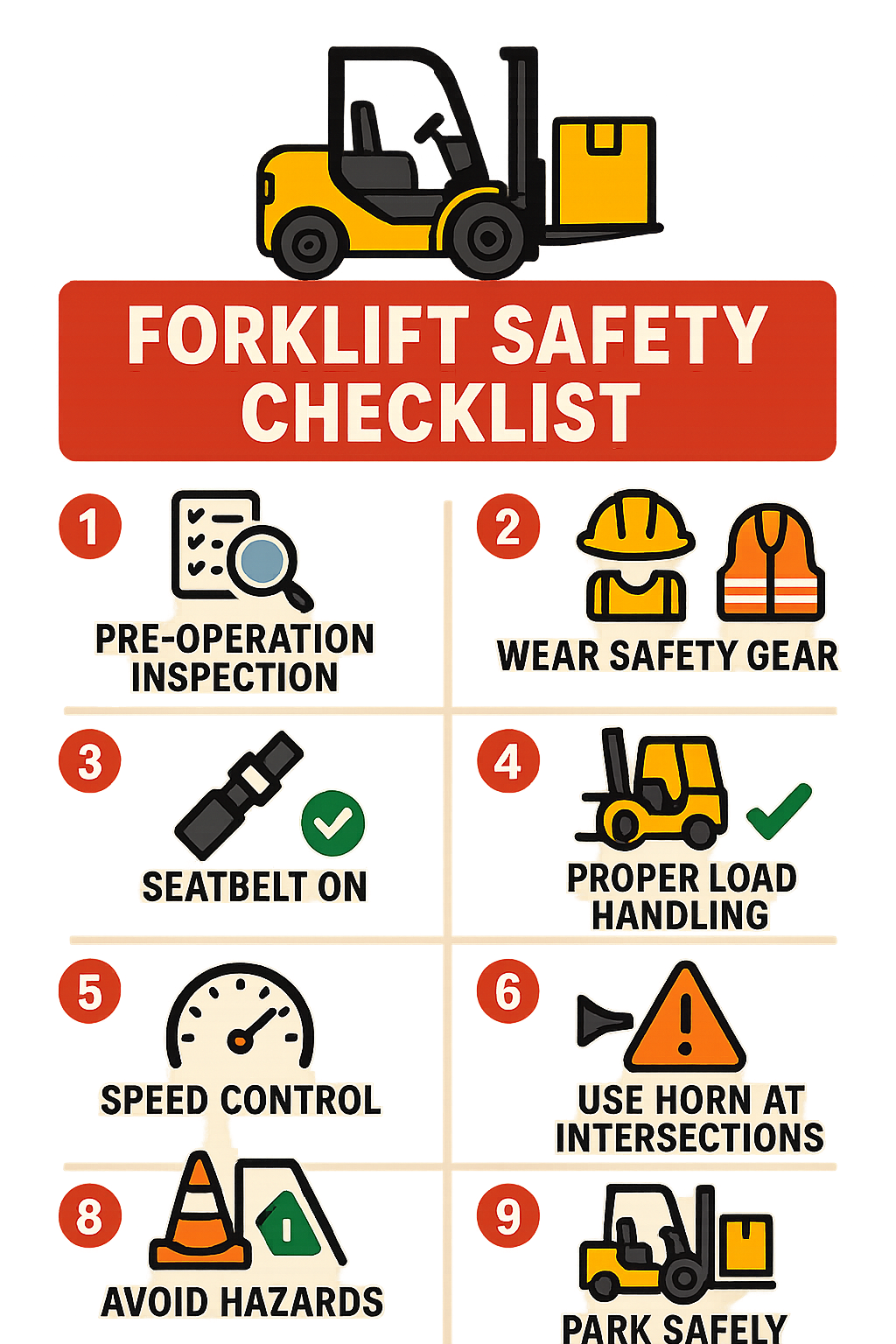
Daily Pre-Operational Checks:
- Visual Inspection: Check for damage, leaks, worn tires, and structural issues
- Battery/Fuel: Verify adequate charge or fuel levels for shift requirements
- Hydraulic Systems: Test lift/lower functions and check fluid levels
- Brakes: Verify proper operation of service and parking brakes
- Steering: Confirm normal operation without excessive play
- Lights & Alarms: Test all warning devices and illumination systems
- Safety Equipment: Inspect seat belts, guards, and emergency devices
- Load Handling: Check fork condition, carriage operation, and mast function
Weekly Supervisory Reviews:
- Documentation Review: Verify daily inspection completion and issue resolution
- Operator Assessment: Monitor safe operating practices and compliance
- Equipment Performance: Evaluate operational efficiency and maintenance needs
- Safety System Status: Confirm proper function of installed safety technologies
Monthly Maintenance:
- Professional Inspection: Comprehensive evaluation by qualified technicians
- Compliance Verification: Ensure regulatory standard adherence
- Training Updates: Review operator competency and provide refresher education
- Incident Analysis: Examine any safety events and implement improvements
Case Studies & Success Stories
UK Warehouse Implementation demonstrates measurable safety improvements through comprehensive technology deployment. One major logistics facility achieved 45% accident reduction following installation of integrated camera and proximity sensor systems. Insurance premium reductions of 20% offset initial investment costs within 18 months.
Conclusion
Effective forklift safety solutions represent essential investments in operational sustainability, worker protection, and regulatory compliance. The evidence demonstrates that comprehensive safety programs combining advanced technology, proper training, and systematic maintenance deliver measurable improvements in accident prevention and operational efficiency.
Organizations implementing integrated safety approaches achieve significant ROI through reduced insurance costs, decreased downtime, and improved productivity. Technology investments averaging £15,000 typically generate annual savings exceeding £50,000 while creating safer working environments for all personnel.
Warehouse forklift safety requires ongoing commitment to best practices, regulatory compliance, and continuous improvement. The rapid evolution of safety technologies provides unprecedented opportunities to eliminate workplace hazards and protect valuable human resources.
Request a forklift safety assessment for your facility to identify improvement opportunities and develop customized solutions. Share this guide with safety officers and plant managers to promote industry-wide safety improvements and collaborative learning.
Contact SharpEagle Technology for comprehensive safety consultations and custom solution development tailored to your specific operational requirements and regulatory obligations.
