

Summary
Nottingham distribution hubs face unique blind spot challenges in high-volume operations. 360° forklift vision systems provide comprehensive bird-eye view coverage, eliminating dangerous blind zones and reducing collision incidents by up to 70%. This technology transforms operator safety, improves precision, and ensures HSE compliance across East Midlands logistics facilities.Nearly 55% of forklift accidents in UK distribution hubs occur due to blind spots, particularly in busy regions like Nottingham where high-volume picking and fast-moving operations dominate daily activities. The East Midlands logistics corridor has become a critical hub for national distribution, with facilities handling millions of pallets annually under intense time pressures.
Nottingham distribution safety faces mounting challenges as facilities including East Midlands Gateway, Colwick Industrial Estate, and Blenheim Industrial expand operations to meet e-commerce demands. Tight aisle spaces, fast-paced pallet movement, and mixed pedestrian-forklift traffic create hazardous environments where traditional safety measures struggle to prevent incidents.
Collision risks multiply in zones where forklift blind spots intersect with pedestrian pathways, loading dock activities, and multi-equipment operations. The solution revolutionizing safety across Nottingham's logistics sector is 360° forklift vision systems that provide clearest, real-time, all-angle visibility reducing blind spots, improving operator accuracy, and enhancing warehouse safety fundamentally.
The Real Blind-Spot Challenges in Nottingham Distribution Hubs
Understanding Forklift Blind Zones
Forklift blind spot elimination addresses critical visibility gaps inherent to equipment design. Mast obstruction blocks upward and forward visibility when loads are elevated. Rear visibility gaps prevent operators from seeing pedestrians or obstacles behind equipment. Side angle limitations create danger zones where approaching personnel or equipment remain invisible until collision becomes imminent.
Nottingham-Specific Risk Factors
East Midlands warehouse safety confronts unique operational pressures:
High-Speed Order Fulfilment: E-commerce distribution demands rapid pallet movement through congested aisles where visibility challenges multiply with operational pace. Operators under time pressure make quick decisions with incomplete visual information.
Peak-Season Congestion: Major logistics operators including Amazon, Boots, and DHL experience seasonal volume surges that pack warehouse floors with maximum equipment and personnel density. These conditions transform minor visibility limitations into serious accident risks.
Night-Shift Operations: Reduced lighting during overnight operations compounds visibility challenges, making pedestrian detection increasingly difficult even for alert operators.
Common Accident Scenarios
Pedestrian Approaching from Rear: Workers walking behind reversing forklifts enter blind zones where operators cannot detect their presence until impact occurs or near-miss creates dangerous situation.
Forklift Turning into Congested Aisles: Executing turns in narrow aisles without complete side visibility leads to collisions with racking, stored inventory, or other equipment operating in adjacent spaces.
Reversing Collisions at Loading Bays: Backing into loading positions without comprehensive rear visibility creates risks of striking dock equipment, trailers, or personnel working in bay areas.
Legal Compliance Requirements
UK forklift safety technology must address regulations including HSE INDG 457 guidance on workplace transport safety, PUWER compliance requiring equipment to minimize risks, and Warehouse Safety Regulations mandating appropriate visibility provisions for mobile equipment operations.
What Is a 360° Forklift Vision System?
A bird-eye view forklift camera system employs four wide-angle cameras strategically installed at front, rear, left side, and right side positions on forklift equipment. Advanced processing technology merges these four video feeds in real-time, creating single aerial perspective display showing complete equipment surroundings as if viewed from above.
This forklift 360 camera system eliminates traditional blind zones by providing operators with comprehensive visibility that exceeds what human vision can achieve even under optimal conditions. The bird-eye perspective simplifies spatial awareness, enabling operators to understand precisely where equipment boundaries exist relative to surrounding obstacles, personnel, and other vehicles.
Operator Benefits
Zero Blind Spots: Complete perimeter visibility ensures operators can detect any object, person, or equipment approaching from any direction, eliminating the guess-work inherent in traditional mirror-based visibility systems.
Better Turning Judgement: Understanding exact clearances on both sides during turning maneuvers prevents racking strikes, inventory damage, and collision with adjacent equipment.
Safer Reverse Positioning: Comprehensive rear visibility combined with side awareness enables confident reversing in congested areas without requiring spotters or excessive caution that slows operations.
Faster Pallet Manoeuvring: Precision visibility enables quicker, more accurate pallet placement and retrieval, improving productivity while maintaining safety standards.
Why Nottingham Warehouses Prefer 360° Vision Over Standard Cameras
Traditional rear-view forklift camera systems provide limited perspective covering only single angles. Standard installations might include front-facing camera for forward visibility and rear camera for backing operations, but these configurations leave dangerous side blind zones completely unaddressed.
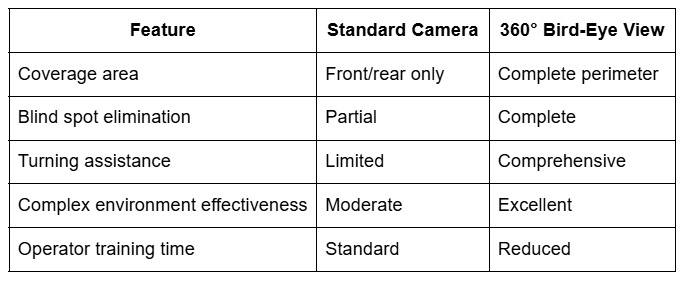
Warehouse forklift camera system preferences in Nottingham reflect specific operational realities:
Heavy E-Commerce Order Density: High-volume picking operations demand maximum efficiency and safety. Complete visibility enables operators to maintain pace while ensuring pedestrian protection.
Inexperienced Temporary Workers: Seasonal staffing includes operators with varying experience levels. Forklift operator visibility enhancement through 360° systems compensates for experience gaps, enabling safer operations from newer personnel.
Multi-Shift Operations: Continuous 24-hour operations increase human-equipment interaction points. Comprehensive visibility systems provide consistent safety regardless of shift timing or ambient lighting conditions.
Key Safety Benefits of 360° Forklift Vision in Nottingham Hubs
Forklift blind spot elimination delivers measurable safety improvements across multiple operational dimensions:
Complete Blind-Spot Elimination: Four-camera coverage removes all visibility gaps, ensuring operators can detect hazards from any approach angle before dangerous situations develop.
Enhanced Turning Accuracy: Precise spatial awareness prevents the racking strikes and inventory damage that occur when operators misjudge clearances during aisle navigation.
Safer Reversing at Loading Docks: Comprehensive rear and side visibility enables confident backing into loading positions without collision risks that damage equipment or injure personnel.
50-70% Reduction in Human Error: Visual clarity reduces misinterpretation of spatial relationships, dramatically lowering incidents caused by visibility limitations rather than operator negligence.
Reduced Vehicle-to-Vehicle Collisions: Multi-equipment environments benefit from improved awareness preventing forklifts from striking each other during simultaneous operations in shared spaces.
Faster Pallet Retrieval and Placement: Forklift visibility enhancement enables more efficient operations as operators spend less time verifying clearances and more time executing productive movements.
Higher Operator Confidence: Comprehensive visibility reduces stress and uncertainty, enabling operators to work more confidently and consistently across varying conditions.
Where to Install 360° Vision for Maximum Safety
Strategic deployment of forklift 4-camera system installations maximizes safety impact across critical operational zones:
Cross-Docking Bays: High-activity transfer points where multiple forklifts and personnel converge benefit enormously from complete visibility preventing the frequent near-misses these areas typically experience.
High-Speed Picking Aisles: Narrow corridors with intense equipment traffic require precision navigation that 360° visibility enables, preventing the inventory damage and equipment collisions common in congested picking zones.
Cold Storage Warehouses: Low-temperature environments often feature reduced lighting and frost-covered surfaces that impair visibility. Camera systems maintain clear visual feed regardless of these challenging conditions.
Goods-In Goods-Out Lanes: Loading and unloading zones with mixed pedestrian and equipment traffic represent high-risk areas where comprehensive visibility prevents common accident scenarios.
Mixed Pedestrian Pathways: Any zone where warehouse workers regularly walk near forklift operations requires enhanced visibility ensuring equipment operators can detect and avoid personnel.
Installation follows PUWER and HSE guidelines ensuring camera positioning, mounting security, and display placement optimize safety effectiveness while maintaining regulatory compliance.
Combining 360° Vision With Other Forklift Safety Systems
Maximum logistics hub safety solution effectiveness emerges from integrating multiple complementary technologies:
AI Forklift CCTV: Intelligent monitoring systems that detect pedestrians and trigger automated warnings complement 360° visibility by adding predictive safety layer.
RODS-L Radar Object Detection System: Proximity sensors that detect objects in blind zones provide additional hazard alerts reinforcing visual information from camera systems.
Forklift Safety Lights: Blue Spot approach warnings, Red Danger zone lights, and ARC perimeter illumination create visual communication that pedestrians recognize, complementing operator visibility enhancements.
Blind Spot Detection Forklift: Radar-based detection systems working alongside camera feeds provide redundant safety verification ensuring hazards trigger alerts through multiple channels.
Explosion-Proof Camera/Lights: Specialized equipment for chemical storage hubs ensures comprehensive safety solutions remain available even in hazardous atmosphere environments.
This integrated ecosystem approach delivers forklift collision reduction exceeding what any single technology achieves independently, creating robust safety infrastructure appropriate for Nottingham's demanding distribution environments.
Best Practices for Nottingham Distribution Warehouses
Maximizing warehouse forklift camera system effectiveness requires systematic operational integration:
Daily Visual Inspection: Operators should verify camera cleanliness and functionality during pre-shift equipment checks, ensuring visual feed quality remains optimal throughout operations.
Comprehensive Operator Training: Personnel require thorough instruction on interpreting bird-eye view perspective, understanding display information, and integrating visual data into safe operating practices.
Alignment With Warehouse Flow: Camera systems should complement facility traffic patterns, floor markings, and operational procedures creating cohesive safety ecosystem rather than isolated technology.
Monthly HSE Safety Audits: Regular assessment of camera system performance, incident patterns, and safety metrics ensures continuous improvement and identifies optimization opportunities.
Retro-Reflective Marking Integration: Combining enhanced visibility technology with high-visibility floor markings creates layered safety approach addressing both equipment operator awareness and pedestrian hazard recognition.
Maintenance and Inspection Checklist
Sustained forklift visibility enhancement requires consistent maintenance protocols:
- Camera lens cleaning to remove dust, condensation, and debris
- HDMI and monitor wiring inspection ensuring secure connections
- Calibration verification maintaining accurate bird-eye view geometry
- Recording system health checks confirming footage capture for safety audits
- Weekly inspection logging documenting maintenance activities for compliance
Conclusion
360° forklift vision systems have become preferred safety technology across Nottingham distribution safety operations because they directly address the blind-spot challenges that cause majority of warehouse accidents. By providing comprehensive bird-eye view coverage, these systems eliminate dangerous visibility gaps while enabling faster, more confident equipment operation.
Ready to eliminate blind spots and reduce collision risks in your Nottingham distribution operation? SharpEagle's 360° Forklift Vision System delivers comprehensive visibility solutions tailored for UK logistics environments. Our proven technology provides the clearest, most reliable bird-eye view coverage available, ensuring your operators have complete situational awareness throughout every shift.
Contact SharpEagle today to discover how 360° forklift vision can transform your warehouse safety performance, reduce incident rates, and improve operational efficiency across your facility.
Frequently Asked Questions
How does a 360° forklift vision system reduce accidents?
The system eliminates all blind spots by providing bird-eye view coverage showing complete equipment surroundings in real-time. Operators can detect pedestrians, obstacles, and other equipment approaching from any direction, preventing the collision scenarios that cause 55% of forklift accidents. Complete visibility enables safer turning, reversing, and navigation through congested areas.
Why is it important for Nottingham's distribution hubs?
Nottingham facilities face unique challenges including high-volume e-commerce operations, tight aisle configurations in older warehouses, seasonal congestion from major logistics operators, and multi-shift operations increasing human-equipment interaction. These factors multiply blind-spot risks that 360° vision systems directly address, making the technology particularly valuable for East Midlands warehouse safety.
Can the system work in low-light or night shifts?
Yes, modern 360° forklift camera systems incorporate low-light sensitive sensors that maintain clear visibility during night operations. Many systems include infrared capabilities providing excellent image quality even in minimal lighting conditions common during overnight warehouse shifts.
Is it compatible with all forklift types?
360° vision systems install on virtually all forklift models including counterbalance, reach trucks, pallet jacks, and specialized equipment. Universal mounting brackets and adaptable camera positioning ensure compatibility across diverse equipment fleets operating in distribution environments.
