

Summary
UK warehouses are busier and more automated than ever, and reversing forklifts remain one of the biggest safety risks on site. This guide explains how forklift reversing camera and sensor systems work, why mirrors alone are no longer enough, and what UK facilities should look for when choosing a system. It covers camera-only, sensor-only and integrated setups; key buying mistakes to avoid; and where this technology is heading next.Introduction
UK warehousing has grown fast, pushed along by online retail, quicker delivery promises and more automated sites. That growth has brought a lot more forklift traffic onto busy floors, with longer shifts and tighter turnaround times becoming the norm. Safety has moved up the priority list too, and reversing manoeuvres sit at the centre of that concern, since a forklift moving backward has less visibility and less time to react. This is exactly why a properly specified forklift reversing camera system UK operators can trust has become such an important part of everyday site safety, working alongside sensor technology that extends awareness beyond what the eye alone can manage.
Why Reversing Accidents Remain a Major Safety Challenge
Reversing incidents rarely comes from one cause alone. Blind spots are a common one, since large loads or high masts often hide what is directly behind the vehicle. Pedestrian movement adds risk too, as pick teams and visitors cross active vehicle routes throughout the day. Narrow aisles leave little room for error, and loading docks combine reversing manoeuvres with congested, fast moving traffic. Human error, whether fatigue or a simple misjudged distance, is always part of the picture as well, and it is one of the main reasons a proper forklift blind spot detection system has become standard rather than a nice-to-have.
The results show up as injuries, damaged equipment, lost stock, downtime and rising insurance costs, which is exactly the kind of warehouse collision prevention challenge mirrors alone were never built to solve. A fixed mirror gives a narrow view and depends on the operator remembering to check it at the right second, which is simply not enough on a busy modern floor.
Read More : The Complete Guide to Forklift Safety Solutions - Types, Regulations & Best Practices
What Is a Forklift Reversing Camera & Sensor System?
A forklift camera and sensor system brings together a rear-mounted camera, radar or ultrasonic sensors, an in-cab monitor, audible alarms and visual warning lights, all working as one unit rather than separate add-ons. In practice, this is the foundation that any well-built forklift reversing camera system UK site fits as part of its wider safety plan.
There are three common approaches. Camera-only setups give a live picture but rely on the operator noticing it. Sensor-only setups detect obstacles automatically but skip the visual reference. Integrated systems combine both, which is why a properly built forklift rear-view camera system paired with radar tends to give the strongest overall result on site.
How Forklift Camera & Sensor Systems Work
The process is simple in practice. Once the forklift begins reversing, the camera switches on, and the monitor shows the live rear view. At the same time, radar sensors scan the surrounding zones, and if something enters that range, an alert sounds, often growing more urgent as the object gets closer. The operator then slows, stops or adjusts course, a routine that only works because a properly fitted forklift reversing camera system's UK operation gives that early warning in the first place.
Radar works well regardless of lighting and can catch objects a camera might miss, such as someone standing just outside the lens angle. This is the layered approach that makes a genuine forklift radar sensor system so effective, and it is also what sets apart a well-built forklift reversing safety system from a basic camera fitted on its own, since a forklift reverse camera UK buyers pick up cheaply rarely includes any radar coverage at all.
Why UK Warehouses Need Reversing Camera Systems
The risk profile changes by site type. Warehouses see constant reversing between aisles and bays; distribution centres run dense multi-shift traffic; manufacturing plants mix forklift movement with production activity; logistics hubs deal with frequent vehicle changeovers; ports handle heavier loads outdoors; and cold storage sites add condensation and low light into the mix.
Major logistics regions including Birmingham, Manchester, Liverpool, Southampton and Leeds have all seen forklift use climb as distribution networks expand around key transport routes. Higher vehicle throughput means higher baseline risk, which is why proper warehouse forklift safety solutions have become standard planning for operations managers rather than an afterthought. Sites weighing up their options usually find that pairing a solid forklift reversing camera system UK with genuine forklift visibility solutions UK expertise gives the fastest return through fewer incidents and less downtime, and a well-positioned forklift rear view camera system is often the single upgrade that makes the biggest difference.
Key Benefits of Reversing Camera & Sensor Systems
Improved Rear Visibility gives operators a direct view instead of relying on memory or a quick mirror check.
Reduced Blind Spots come from pairing a camera feed with radar coverage, closing the gaps mirrors cannot reach, which is the core purpose behind any real forklift blind spot detection system.
Better Pedestrian Safety improves as audible and visual alerts give people extra warning near crossings and dock areas, which is the practical value of a genuine forklift pedestrian detection system.
Fewer Collisions and Lower Repair Costs follow naturally once racking, stock and vehicle contact drops.
Improved Operator Confidence and Productivity show up as drivers reverse with less hesitation across a full shift.
Reduced Downtime keeps operations moving instead of waiting on repairs, which is why many sites now treat a forklift collision avoidance system UK as standard rather than optional kit and why a complete forklift reversing camera system UK package tends to pay for itself quickly.
Camera Only vs Sensor Only vs Integrated Systems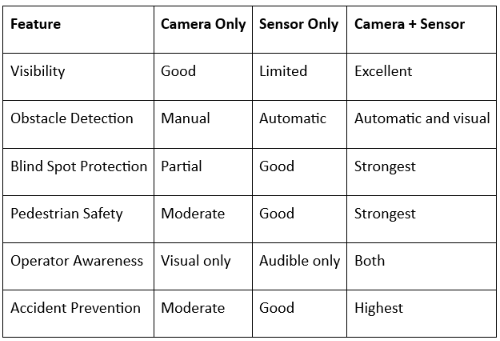
Camera only setups suit narrow reversing lanes but still depend on someone watching the screen. Sensor only setups catch obstacles automatically but give no visual confirmation. An integrated forklift camera and sensor system brings both together, which is why most safety focused sites now treat it as the baseline rather than a premium extra, and it is the clearest example of what a properly specified forklift safety camera system should actually deliver. It is also, in effect, the simplest working definition of a genuine forklift collision avoidance system UK sites can rely on day to day.
Read More : Boost Workplace Safety with a Smart Forklift Alert System
Key Features to Look for Before Buying
Look past marketing and focus on the specification. HD camera quality keeps the feed safety-focused in low light. Wide viewing angles reduce the chance of anything sitting just outside the frame. Radar detection adds automatic sensing that does not depend on the operator watching constantly, the backbone of any dependable forklift radar sensor system. Multi-zone alerts let distant objects trigger a gentler warning than something close by. IP69K protection matters for dust, moisture or washdown routines. Night visibility keeps the feed usable on early or late shifts, and durable construction handles daily vibration and knocks. Easy installation keeps downtime low when fitting or replacing kit, and together these features are what turn a basic camera into a genuine forklift blind spot detection system rather than just a screen in the cab.
Industrial grade components matter here, since a system built for daily forklift use needs to handle impacts and temperature swings in a way a basic forklift reverse camera UK bought online rarely can.
Why SharpEagle Reversing Camera & Sensor Systems Stand Out
SharpEagle builds around real operational performance rather than a features list. Systems use industrial grade design so parts hold up under daily use; radar-based detection for automatic sensing alongside a clear picture; multi-zone monitoring so alerts feel proportionate rather than constant; and real-time alerts the moment something enters a zone. High definition visibility keeps the feed sharp across a full shift, and harsh environment performance keeps everything working reliably in cold storage or dusty yards.
Taken together, this is what a properly engineered forklift reversing camera system UK setup should deliver, and it is a strong example of genuine forklift visibility solutions UK expertise in practice, built on the same principles that make any forklift safety camera system worth trusting on a busy site.
Applications Across UK Industries
Warehousing sees constant reversing between aisles and bays. Logistics operations need clear rear visibility for fast vehicle turnaround. Manufacturing sites mix forklift movement with production activity, increasing crossing points. Food and beverage facilities add cold storage and washdown demands, making sealed, durable equipment important. Retail distribution centres run high volume picking where speed and safety both matter, and ports handle heavier loads outdoors where visibility can change quickly, which is exactly why a properly rated forklift reverse camera UK teams choose for outdoor use needs to handle weather as well as dust.
Across all of these settings, the goal is the same: giving operators real awareness, which is the practical foundation behind wider material handling safety systems planning and why so many teams are formalising their warehouse forklift safety solutions as standard site policy. Whatever the sector, the starting point is usually the same too: a properly chosen forklift reversing camera system UK fitted to match the site.
Common Buying Mistakes
Choosing a camera-only kit can create a false sense of security if nobody watches the screen at the right moment. Ignoring detection range leaves sensors either too sensitive or not sensitive enough. Poor camera placement wastes even a good camera if the angle misses key blind spots. Consumer-grade equipment tends to fail faster under daily industrial use, which is a common problem with a basic forklift reverse camera UK teams sometimes buy without checking the build quality first. Ignoring environmental ratings risks failure in cold storage or washdown areas, undermining the whole forklift rear view camera system investment, and skipping maintenance planning shorten the life of what may have started as a solid forklift reversing safety system.
Read More : Forklift Safety Solutions: Top 12 Hazards & How to Avoid Them
Future Trends in Forklift Safety Technology
AI powered detection is starting to tell people, vehicles and static objects apart more accurately, cutting false alerts while catching genuine hazards faster. Smart warehouses are linking safety systems into wider site monitoring; connected forklift fleets let managers review data across a whole site, and automated alerts are increasingly tied into site wide alarms rather than staying isolated to one vehicle. Pedestrian detection keeps improving too, recognising people specifically rather than just general movement. Camera and sensor technology works best as one part of a wider strategy alongside training, layout planning and clear procedures, and any forklift camera and sensor system fitted today should be able to grow into these smarter, more connected setups over time.
Conclusion
Reversing forklifts will always carry some risk, but that risk can be managed far better with the right mix of visibility and automated detection. Better rear visibility, stronger collision prevention and safer conditions for pedestrians are no longer optional extras on busy UK sites; they are becoming standard practice, and a properly specified forklift reversing camera system UK solution, backed by a genuine forklift collision avoidance system UK teams can trust, is becoming a core part of modern warehouse safety programs.
Ready to Improve Forklift Visibility on Your Site?
Looking to improve forklift visibility and reduce reversing accidents? Speak with SharpEagle's safety specialists to learn how forklift reversing camera and sensor systems can help improve awareness, reduce blind spots and create safer warehouse operations.
Request a Consultation | Download Product Datasheet | Talk to a Safety Expert
Frequently Asked Questions
Q1. What is a forklift reversing camera system?
It gives operators a live view behind the vehicle while reversing. A warehouse fitting one often sees fewer racking collisions within weeks. It removes reliance on mirrors and guesswork, and related detection accessories are usually listed on the product page.
Q2. How does a forklift camera and sensor system work?
The camera activates on reverse, showing a live feed while radar sensors scan for obstacles and trigger alerts. In a busy distribution centre this means an operator sees and hears a warning before a pedestrian steps into the path, cutting reaction time noticeably.
Q3. Why are blind spots dangerous when reversing a forklift?
Blind spots hide people, stock or equipment from view, especially with a tall load. A pallet blocking a pedestrian crossing behind the vehicle is a classic example. Closing that gap is one of the clearest safety gains available on any site.
Q4. What is the difference between a reversing camera and a radar sensor?
A camera gives a picture to interpret, while a radar sensor detects objects automatically without needing to be watched. A busy loading bay benefits from both, since a missed glance at the screen does not then mean a missed hazard.
Q5. Are reversing camera systems suitable for all forklift types?
Most systems adapt to counterbalance trucks, reach trucks and other warehouse vehicles, though mounting positions vary. A reach truck in narrow aisles may need a slightly different angle to a standard counterbalance unit, but visibility gains carry across a mixed fleet.
Q6. Can these systems help improve pedestrian safety?
Yes, audible and visual alerts give pedestrians extra warning as a forklift reverses nearby, particularly at junctions and dock areas. Sites with shared walkways often report fewer near-miss incidents once a proper forklift-pedestrian detection system is fitted.
Q7. What detection range should a forklift sensor system have?
Range depends on layout, but configurable zones that trigger gentler alerts further out and sharper ones close in usually work best. A wide loading yard needs more range than a tight racking aisle, and getting this right avoids both false alarms and missed hazards.
Q8. Are reversing camera systems suitable for outdoor use?
Yes, provided the equipment carries a rating such as IP69K for dust and moisture. A freight yard exposed to rain and grit needs sturdier housing than an indoor-only setup, and rated outdoor options are usually listed separately by suppliers.
Q9. Which industries benefit most from forklift collision avoidance systems?
Warehousing, logistics, manufacturing, food and beverage, retail distribution and ports all see real gains, since each involves frequent forklift movement around people and stock. Cold storage sites in particular benefit from both collision prevention and durable, condensation-resistant kit.
Q10. How do I choose the right forklift reversing camera system for my warehouse?
Start with your busiest reversing zones, typical load sizes and site conditions, then match those to camera quality, detection range and durability ratings. A cold storage site needs different specifications to an open yard, and most suppliers offer a consultation to help match equipment to the site.
