

Summary
Since Brexit, UK facility and safety managers have had to navigate two overlapping certification systems for equipment used in explosive atmospheres. This guide breaks down UKCA vs ATEX marking, explains which one actually applies to your site today, and walks through a practical compliance checklist for industrial, automotive, offshore, and oil and gas facilities across the UK.Key Takeaway
Brexit created two certification systems: ATEX still governs the EU and Northern Ireland, while UKCA is Great Britain's own mark for England, Scotland, and Wales.
The two aren't rivals right now — Great Britain currently accepts CE/ATEX-marked equipment without a separate UKCA mark, and that recognition has been extended indefinitely for most categories.
UKCA doesn't apply in Northern Ireland, which continues to follow CE and UKNI arrangements; many manufacturers apply both marks anyway to stay sellable in both markets.
Deadlines and guidance have shifted repeatedly, so check current GOV.UK guidance rather than older articles for exact dates.
Non-compliant equipment on hazardous sites risks HSE enforcement, invalidated insurance, liability after an incident, and project delays — making certification an operational requirement, not paperwork.
A sound routine: audit every item for ATEX/UKCA marking, verify conformity declarations match what's installed, confirm the issuing body, and plan replacements for anything falling out of compliance.
Introduction
Brexit changed a lot of things quietly, and equipment certification for hazardous environments is one of them. Years later, plenty of facility managers and safety officers still aren't entirely sure whether their explosion proof gear needs a UKCA mark, an ATEX mark, or both. It's an easy thing to get confused about, especially when government guidance keeps shifting.
This matters more than most people realise if you're running an industrial plant, an automotive manufacturing line, or working offshore on a rig where a single piece of non-compliant equipment could mean real safety and financial consequences. In this article, we'll walk through what each marking actually means, how UKCA vs ATEX marking compares, what the current rules look like, and what it means for the equipment sitting on your site right now.
What Is ATEX Marking?
ATEX marking comes from EU legislation, specifically Directive 2014/34/EU, and it governs equipment intended for use in potentially explosive atmospheres. In practice, ATEX is really two directives working together: 2014/34/EU covers the equipment itself, while 1999/92/EC deals with the workplace and how employers manage explosive atmosphere risks on site.
You'll often see references to zone classifications under ATEX, things like 'Zone 0', '1', and '2' for gas risks and 'Zone 20', '21', and '22' for combustible dust. We won't go deep into the technical zoning here, but it's worth knowing these zones exist because they determine what kind of ATEX certified equipment a site actually needs.
Even after Brexit, ATEX marking hasn't disappeared from relevance in the UK. It still matters for equipment destined for the EU market, and it continues to apply in Northern Ireland under the terms of the Northern Ireland Protocol.
What Is UKCA Marking?
In short, it stands for UK Conformity Assessed, and it was introduced as Great Britain's own replacement for the CE mark after Brexit. UKCA applies only in England, Scotland, and Wales, not in Northern Ireland, which continues to follow separate arrangements.
The UKCA certification process sits under the UK's own version of the equipment for explosive atmospheres regulations, largely mirroring the old EU framework but administered independently. One thing worth flagging for anyone reading this later on: the government's position on UKCA deadlines have shifted more than once, so it's worth checking the latest guidance on GOV.UK rather than relying on older articles, including this one, for the exact current date.
UKCA vs ATEX: Key Differences
Here's a simple way to compare the two systems side by side.
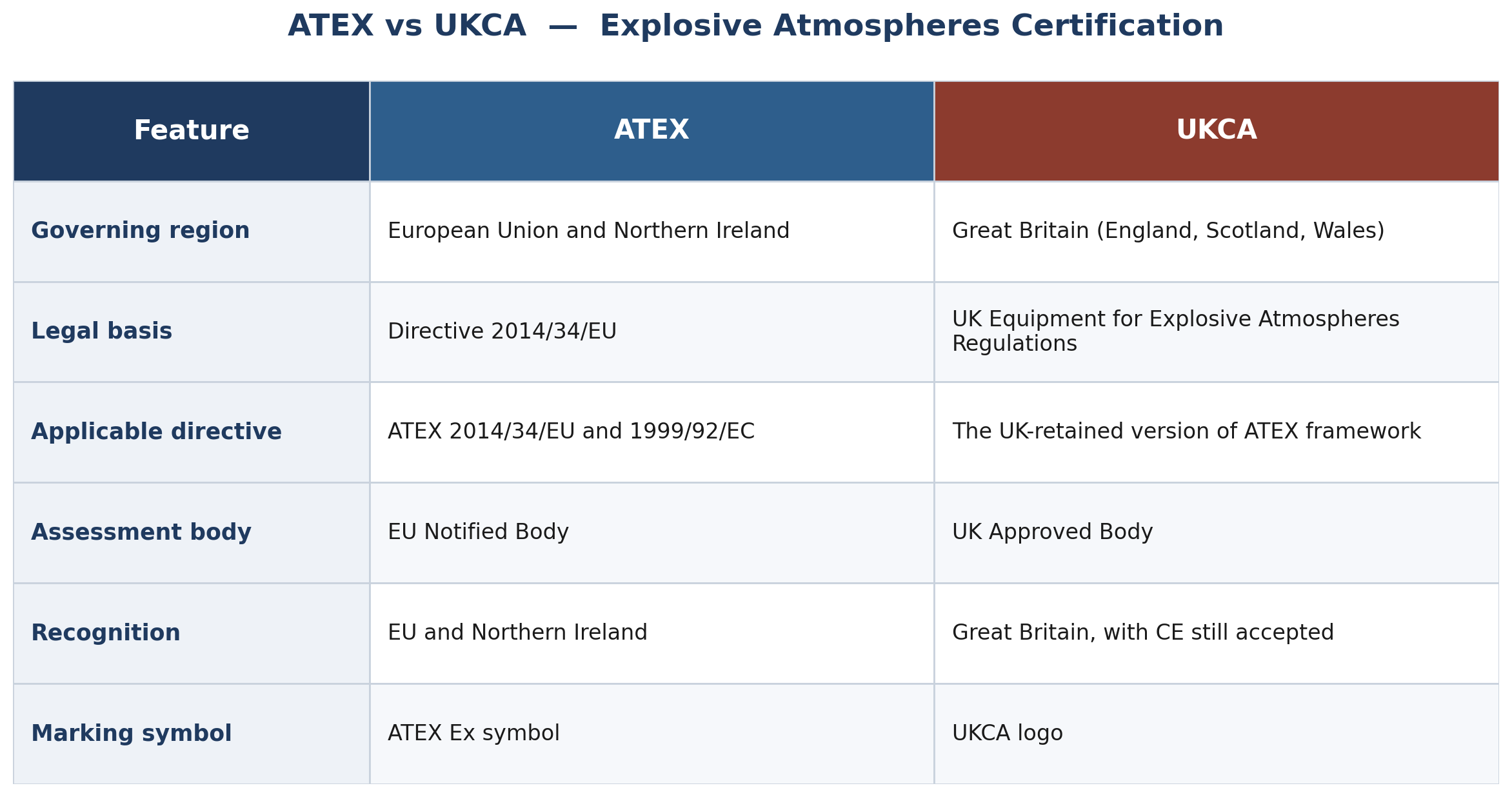
One thing worth understanding about UKCA vs CE marking is that they aren't actually rivals right now. Current UK policy allows CE-marked equipment for potentially explosive atmospheres to continue being placed on the Great Britain market without a separate UKCA ex certification, and this recognition has been extended indefinitely for most Department for Business and trade categories, ATEX included. That said, plenty of manufacturers still choose to apply both marks anyway, simply because it keeps their equipment flexible for both UK and EU customers without maintaining two separate product lines.
Why This Matters for Hazardous Sites in the UK
This is where the practical stakes really show up, and it looks different depending on your industry.
In industrial facilities handling chemical processing or manufacturing with flammable dust or gas present, properly certified equipment isn't optional; it's the baseline requirement for keeping people safe. In automotive manufacturing, paint shop options and EV battery lines involve solvents and flammable vapours that demand proper hazardous location certification on every piece of electronic equipment nearby.
Offshore and onshore rigs bring their own challenges too, often dealing with the strictest Zone 1 and Zone 2 classifications alongside remote monitoring needs that make reliable, certified equipment even more important. And in oil and gas, whether at refineries or storage terminals, the stakes for using non-compliant gear are about as high as they get, both for safety and for regulatory exposure. Anyone pursuing UKCA certification oil and gas UK should treat it as a core operational requirement, not paperwork.
Getting this wrong isn't just a compliance headache. It can mean HSE enforcement action, invalidated insurance policies, liability if an incident occurs, and delays to projects that are already running on tight schedules.
Compliance Checklist for Facility and Safety Managers
If you manage a hazardous site, here's a practical way to get your equipment situation under control.
Start by auditing every piece of equipment on site and noting whether it carries ATEX marking, UKCA marking, or both. Then check your supplier and manufacturer conformity declarations to confirm they're current and match what's actually installed. Confirm which UK approved body issued each certification where relevant, and pull the zone classification documentation for your site so it's ready if anyone asks for it.
From there, build a rough roadmap for upgrading or replacing anything that's falling out of compliance, and make sure your site personnel actually know how to recognise the different markings when they see them on new equipment.
Not sure if your site's equipment meets current marking requirements? SharpEagle's team can help you assess compliance gaps before they become a problem.
Choosing the Right ATEX or UKCA Certified Equipment
None of this matters much if the equipment itself isn't up to standard. Surveillance and safety electronics installed in hazardous zones carry real ignition risk if they aren't properly rated, since a spark from an uncertified camera or sensor can be exactly the kind of thing ATEX and UKCA rules exist to prevent.
That's why choosing properly certified gear, from an ATEX-rated camera to broader hazardous area equipment UK sites already rely on, isn't a box-ticking exercise. It's genuinely part of keeping a site safe. Under the ATEX Directive, UK sites still reference explosive atmosphere risk, and under UKCA rules that apply in parallel, any camera or sensor near a hazardous zone should carry proper ATEX certified equipment status before it ever gets installed. Sourcing genuine explosion proof equipment UK teams can rely on, backed by real hazardous area certification UK inspectors will actually recognise, saves a lot of trouble later.
Introducing SharpEagle ATEX Certified Explosion Proof Cameras
SharpEagle has been working across the UK, since 2009, building a reputation as a trusted partner for safety and security equipment in demanding environments.
Our explosion proof cameras are engineered specifically for Zone 1 and Zone 2 gas environments as well as Zone 21 and 22 dust risks, which makes them suited to oil and gas terminals, offshore platforms, chemical plants, and automotive paint booths alike. Whether you need an ATEX-certified camera for a fixed monitoring point or an ATEX PTZ camera that can cover a wider area from a single mount, our range is built around real ATEX product certification rather than surface-level branding.
Every unit in our lineup is designed to hold up to the rugged demands of hazardous sites while still delivering the surveillance reliability your team depends on, all without compromising on safety. If your facility has been searching for ATEX-approved CCTV cameras that won't need replacing every time regulations shift, this is exactly the gap we've built our product range to fill. From a single ATEX-rated camera on a storage tank to a full site fitted with an ATEX PTZ camera at every access point, we treat every ATEX-certified camera and every one of our ATEX-approved CCTV cameras as safety equipment first and surveillance tech second.
Speak to SharpEagle's compliance experts to assess your site's explosion proof camera requirements.
Conclusion
UKCA and ATEX marking are both still very much part of the UK's regulatory landscape, and for now, that dual reality isn't going away. Getting UKCA vs ATEX marking right isn't about picking a winner; it's about understanding which rules actually govern your site today. Rather than waiting for a deadline to force your hand, it's worth getting ahead of compliance now, auditing what you have, and understanding exactly where your site stands.
Protect your hazardous site with SharpEagle's ATEX-certified explosion-proof cameras, engineered for UK oil and gas, offshore, industrial, and automotive environments. Contact SharpEagle today to request a site assessment.
