

Summary
Warehouses across the UK are busier than ever, and that means more forklifts sharing space with people on foot. This guide walks through what forklift arc lights actually are, how they work, and why so many UK sites are adding them. You'll find a look at different types of forklift safety lighting, buying advice, common mistakes worth avoiding, and where this technology fits alongside other safety measures used in warehousing, logistics, manufacturing, and distribution work.Introduction
Anyone who has spent time on a UK warehouse floor in the last few years has probably noticed how much busier things have gotten. E-commerce fulfillment centers keep expanding, logistics operations run longer shifts, and distribution hubs are moving more stock than they used to. All of that growth brings more forklifts into aisles, loading bays, and walkways where people are working.
More vehicles moving around means more chances for something to go wrong. Operators get trained properly, alarms sound as they should, and yet pedestrian accidents involving forklifts still happen on sites up and down the country. Alarms get missed in noisy environments. Blind spots catch people out. Training only goes so far when someone steps around a corner at the wrong moment.
That's the gap forklift arc lights are designed to fill. They give moving forklifts a visible warning signal that people can spot before they're too close. It's a simple idea, but it's proving effective, which is why forklift arc lights UK adoption keeps climbing among businesses trying to make their floors safer without slowing operations down.
Why Pedestrian Accidents Still Occur in UK Warehouses
It would be easy to assume that with all the training and alarms already in place, accidents should be rare by now. In reality, several everyday factors keep pedestrian incidents on the list of warehouse concerns.
Blind corners are a big one. Racking, stacked pallets, and tight aisle layouts mean someone can walk straight into a path a forklift is already using, with neither person seeing the other coming.
Then there's the sheer volume of activity. In a large facility, people, pallets, and vehicles are moving constantly, and busy environments naturally create more near misses simply because there's more happening at once.
Noise is another factor that doesn't get talked about enough. Warehouses are loud places. Between machinery, forklifts, and general operational noise, an audible alarm can get lost entirely, especially for someone wearing hearing protection or focused on a task.
Loading bays bring their own risks too, since vehicles, pedestrians, and deadlines all collide in one relatively small space. And plain human error plays a part on both sides. Operators get distracted. Pedestrians misjudge distances. It happens, and it's part of why accidents haven't disappeared despite better training.
The knock-on effects are significant. Injuries obviously come first, but there's also product damage, vehicle repair costs, downtime while incidents get investigated, and insurance premiums that climb after repeated claims. Warehouse pedestrian safety has become a genuine priority for good reason, and forklift accident prevention is now something operations managers actively budget for rather than treat as an afterthought. This is exactly why forklift pedestrian safety lights have moved from a nice-to-have to something many sites consider essential.
Read More : Why Pedestrian Forklift Accidents Are Increasing in Warehouses
What Are Forklift Arc Lights?
Put simply, forklift arc lights are LED-based safety lights that project a visible arc of light onto the floor around a moving forklift. Instead of relying purely on sound, they give pedestrians something to see, a clear visual boundary that says a vehicle is close by.
Most systems use either red or blue light, and the choice often comes down to visibility conditions and site preference. Some setups create a halo-style projection around the vehicle, which is why people often refer to them as forklift halo lights. Others produce a defined arc shape ahead of or behind the forklift depending on how it's travelling.
Compared to traditional warning beacons, which flash or rotate to draw general attention, forklift arc safety lights are more targeted. They mark out a specific zone on the ground rather than just signalling that a vehicle exists somewhere nearby. That distinction matters in busy environments where general flashing lights can become background noise that people stop noticing.
How Forklift Arc Lights Work
The technology behind these systems is straightforward, which is part of why they've caught on so quickly.
The light unit gets mounted onto the forklift, usually on the roof guard or another elevated point. Once the forklift starts moving, the LED projects an arc shaped beam onto the floor. Anyone nearby sees this and recognises it as an exclusion zone, a signal to keep their distance until the vehicle has passed.
Beam pattern matters a lot here. A well designed system produces a consistent, clearly defined shape rather than a fuzzy patch of light that's hard to interpret at a glance. LED technology has made this far more reliable than older lighting options, and it holds up well whether the forklift is working indoors under warehouse lighting or outdoors in daylight.
Visibility is really the whole point. In a fast moving environment, people don't have time to stop and think. They need to register the warning instantly, which is why forklift arc lights UK installations tend to focus so heavily on brightness and beam clarity as much as on industrial safety lighting standards generally.
Why UK Warehouses Need Forklift Arc Lights
Different sites face different risks, but arc lights tend to deliver value wherever pedestrians and forklifts share space regularly.
Warehousing is the obvious starting point, given how much forklift movement happens across a typical shift. Distribution centres bring their own challenge too, since they often employ large pedestrian workforces moving between picking areas and loading docks. Manufacturing plants deal with a mix of vehicle types and pedestrian traffic that can get complicated fast, especially on production lines with tight turnaround times.
Logistics facilities run near constant loading and unloading operations, which keeps forklifts moving almost continuously. Retail fulfilment centres face intense, fast paced material movement, particularly around peak seasons. Ports and freight facilities deal with especially complex traffic patterns, combining heavy vehicles, containers, and pedestrian staff in relatively confined spaces.
This isn't limited to one region either. Sites in Birmingham, Manchester, Liverpool, and Southampton are all dealing with similar pressures as freight volumes rise and warehouse footprints grow. Wherever forklift safety lights UK adoption has increased, it tends to follow the same pattern, more traffic, more pedestrians, and a real need for better warehouse safety lighting solutions.
Key Benefits of Forklift Arc Lights
Improved Pedestrian Awareness
The most immediate benefit is simple. People notice a bright arc of light on the floor faster than they register a sound in a noisy environment, which gives them more time to react.
Reduced Collision Risks
Fewer surprises mean fewer near misses, and fewer near misses generally translate into fewer actual collisions over time.
Enhanced Forklift Visibility
Even when the forklift itself is partially blocked by racking or stock, the projected light often isn't, which helps pedestrians spot the vehicle's presence earlier.
Increased Operator Confidence
Operators who know pedestrians can see them coming tend to feel more confident navigating busy areas, which can actually smooth out traffic flow rather than slow it down.
Better Traffic Management
Clear visual signals help establish informal right-of-way patterns in busy intersections, something warehouse managers often notice once lights are installed.
Lower Accident Costs
Fewer incidents mean lower repair bills, less downtime, and, over time, a stronger insurance claims history.
Improved Workplace Safety Culture
There's also a cultural effect. When staff see visible investment in their safety, it tends to reinforce broader safety awareness across the site, supporting material handling safety as a shared responsibility rather than just a management directive.
Read More : Why Combining AI CCTV and Forklift Safety Lights Is the Smartest Move for UK Warehouses
Types of Forklift Safety Lights
Arc lights are just one part of a wider toolkit available to UK warehouses.
Arc Safety Lights
These project the exclusion zone discussed earlier and work well in high-traffic pedestrian areas.
These project a distinct blue dot ahead of or behind the forklift, warning pedestrians before the vehicle itself comes into view around a corner.
Often used to mark a stricter no go area immediately around the vehicle, reinforcing the message that this space belongs to the forklift while it's moving.
The traditional rotating or flashing light most people already associate with industrial vehicles is still useful but less precise than newer projection-based systems.
Laser Guidance Lights
These assist operators with load positioning rather than pedestrian warning, though they're often used alongside the safety lighting systems covered here.
Each of these technologies suits slightly different situations, and many UK sites end up combining two or three of them rather than relying on just one.
Forklift Arc Lights vs Blue Spot Lights vs Red Zone Lights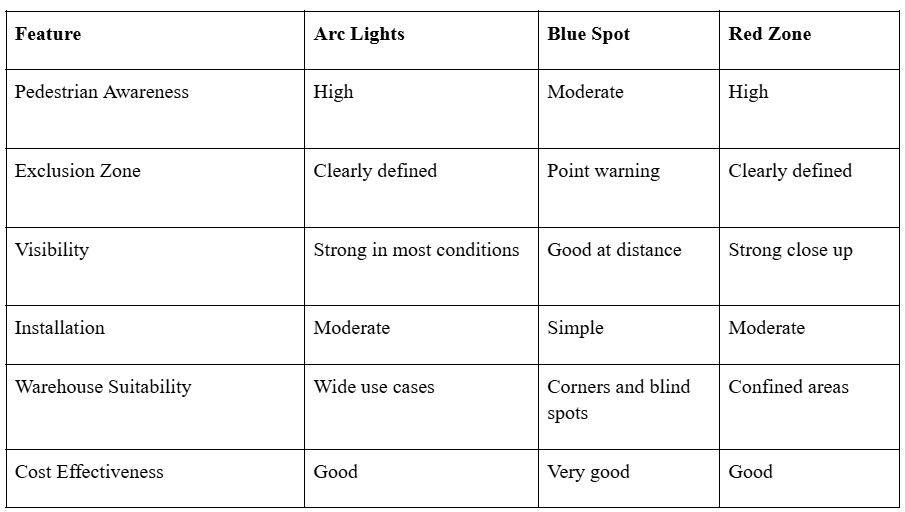
Arc lights tend to work best in open areas with a lot of pedestrian movement, where a defined zone around the whole vehicle matters most. Blue spot lights come into their own around blind corners and intersections, giving people a warning before the forklift is even visible. Red zone lights are often chosen for tighter spaces where a firm, close-range boundary is more useful than a wider projection.
Buying Guide – What to Look for Before Purchasing
Not all forklift arc safety lights are built the same, and the differences show up quickly once a unit is in daily use.
LED brightness matters more than people expect, particularly for sites with bright ambient lighting or outdoor use. Beam quality is just as important, since a sharp, well-defined arc is far easier to interpret than a hazy one. Voltage compatibility needs checking against your existing fleet, since forklifts vary in their electrical systems.
An IP rating determines how well a unit copes with dust, moisture, and general warehouse grime, which matters a lot in food, logistics, or outdoor freight environments. Housing Material affects how well the light survives knocks and vibration over months of daily use and lifespan is worth asking about directly rather than assuming.
Warranty terms tell you a lot about how confident a manufacturer is in their own product, and supplier support becomes important the moment something needs replacing or troubleshooting. Industrial-grade products consistently outperform cheaper consumer alternatives here, mostly because they're built with the vibration, temperature swings, and constant use of a working warehouse in mind from the start.
Why SharpEagle Forklift Arc Lights Stand Out
SharpEagle has built its forklift arc lights specifically around the demands of real industrial environments, rather than adapting general-purpose lighting for the job.
The units use high intensity LED projection designed to stay clearly visible even under strong warehouse lighting or bright outdoor conditions. Housing is built to handle the knocks, vibration, and general wear that come with daily forklift use, which helps the lights hold up well over time rather than degrading after a few months.
Wide voltage compatibility means they fit a broad range of existing forklift fleets without requiring major electrical changes, and installation has been kept straightforward enough that most sites can fit units without extensive downtime. For teams looking for forklift arc lights UK support backed by genuinely industrial-grade components, SharpEagle's approach focuses on solving the practical problems warehouses actually face rather than just adding another accessory to a forklift.
Applications Across UK Industries
Warehousing
High forklift density and constant pedestrian movement make arc lights particularly effective here, giving staff clear visual cues in busy aisles.
Logistics
With loading and unloading happening almost continuously, visual warning systems help manage the steady flow of vehicles and people moving through docks.
Manufacturing
Mixed traffic between production areas and storage zones benefits from the clear exclusion zones arc lights provide.
Food & Beverage
Hygiene sensitive environments still need forklift movement, and arc lights offer a way to maintain safety without adding extra noise to already busy production floors.
Retail Distribution
Seasonal peaks bring sudden spikes in forklift activity, and visual warnings help keep temporary or agency staff safe even without extensive site familiarity.
Ports
Complex traffic patterns involving containers, freight vehicles, and pedestrian staff make clear visual boundaries especially valuable in these high stakes environments.
Read More : How To Increase Warehouse Safety With Forklift Safety Lights
Common Mistakes to Avoid When Buying Arc Lights
Choosing Low-Power LEDs
Dim projections get missed entirely in bright environments, defeating the purpose of the system.
Ignoring IP Ratings
A unit that can't handle dust or moisture will fail faster than expected, leading to unplanned replacement costs.
Poor Mounting Position
Incorrect placement can distort the beam shape or leave blind spots the light was meant to cover.
Purchasing Consumer-Grade Products
These rarely hold up under constant industrial use and often need replacing within months.
Ignoring Maintenance Requirements
Even LED systems need occasional checks, and skipping this can lead to gradual performance decline that goes unnoticed until it's a problem.
Choosing Incorrect Beam Patterns
A pattern suited to wide open aisles won't necessarily work in a tighter, more congested space, and vice versa.
Future Trends in Forklift Safety Lighting
Warehouses are gradually becoming smarter, and forklift safety lighting systems are starting to reflect that shift. AI powered safety systems are beginning to appear on some sites, capable of adjusting warnings based on real time traffic conditions rather than staying static.
Connected safety lighting is another development worth watching, with systems that can communicate across a fleet rather than operating in isolation. Integrated warning technologies, combining lights, alarms, and sensors into a single coordinated system, are becoming more common as Industry 4.0 safety initiatives gain traction across UK manufacturing and logistics.
Arc lights aren't likely to disappear as these trends develop. If anything, they're becoming one part of a broader, more connected forklift safety strategy rather than a standalone solution.
Conclusion
Pedestrian safety remains one of the most persistent challenges in busy UK warehouses, and no single measure solves it completely. Forklift arc lights offer a practical, visible way to reduce risk, giving people the split second warning they need to stay clear of moving vehicles. As adoption grows across warehousing, logistics, and manufacturing sites nationwide, forklift arc lights UK solutions are steadily becoming a standard part of modern warehouse safety programmes rather than an optional extra.
Looking to improve forklift and pedestrian safety in your warehouse? Speak with SharpEagle's forklift safety specialists to discover how forklift arc lights can help reduce collision risks, improve visibility, and support safer operations across your facility.
Frequently Asked Questions
Q1. What are forklift arc lights?
They're LED-based safety devices that project a visible arc onto the floor around a forklift, creating a clear boundary that helps pedestrians recognise when a vehicle is nearby and keep a safe distance.
Q2. How do forklift arc lights improve warehouse safety?
By making moving forklifts more visible ahead of time, they give pedestrians a clear exclusion zone to avoid, which helps prevent accidents before they happen rather than reacting after the fact.
Q3. What is the difference between arc lights and blue spot lights?
Arc lights project a wider zone around the whole vehicle, while blue spot lights typically create a single point of light ahead of or behind it, often used specifically to warn people before the forklift comes around a blind corner.
Q4. Are forklift arc lights suitable for outdoor use?
Many units are, provided they carry an appropriate IP rating for weather resistance and are built with durable housing capable of handling outdoor conditions over time.
Q5. What colour arc light is best for warehouses?
It depends on the site. Red tends to read as an urgent warning, while blue often stands out well against typical warehouse flooring, and many facilities choose based on existing safety colour conventions already in use.
Q6. Can forklift arc lights be fitted to existing forklifts?
Yes, most systems are designed to retrofit onto existing fleets without major modification, though voltage compatibility should always be checked before installation.
Q7. How long do forklift arc lights last?
LED components generally offer a long operational lifespan, though actual longevity depends on usage hours, maintenance, and the quality of the housing and components used.
Q8. Do forklift arc lights replace warning alarms?
No, they're best used alongside alarms rather than instead of them. Combining visual and audible warnings gives the strongest overall safety coverage.
Q9. Which industries benefit most from forklift arc lights?
Warehousing, logistics, manufacturing, and ports all see strong benefits, largely because these environments combine high forklift traffic with regular pedestrian activity.
Q10. How do I choose the right forklift arc light for my operation?
Consider brightness, beam pattern, IP rating, and the level of ongoing supplier support available, then match these against your site's specific layout and operational demands.
