

Summary
UK warehouses are experiencing a safety revolution by combining AI-powered CCTV systems with smart forklift safety lights. This dual-layer approach reduces accident rates by up to 40%, enhances pedestrian awareness, ensures HSE compliance, and creates proactive safety environments. From logistics hubs to cold storage facilities, integrated systems are becoming the new standard for intelligent warehouse management.Let's be honest, UK warehouses have a serious safety problem that traditional measures just aren't solving.
The Health and Safety Executive reports that workplace transport accounts for around a quarter of all workplace fatalities in the UK. Forklift collisions with pedestrians, operators misjudging blind corners, workers stepping into danger zones these incidents happen daily across warehouses in Birmingham, Manchester, Hull, and beyond. The financial impact? Average accident costs range from £15,000 to £50,000 per incident, not counting the immeasurable human cost.
Understanding AI Forklift CCTV Systems
So what exactly is AI CCTV, and why should you care? It's definitely not just fancy cameras with a hefty price tag.
Imagine having a security guard who never blinks, never takes breaks, and can watch 20 different areas simultaneously while analyzing everything in real-time. That's basically what forklift AI CCTV systems do, except faster, more consistent, and without tea breaks.
Here's how it works: AI forklift CCTV systems use intelligent cameras equipped with sophisticated algorithms that actually understand what they're seeing. They're not just recording footage passively like traditional industrial CCTV UK systems, they're actively analyzing it, frame by frame, looking for potential dangers.
What These Smart Cameras Actually Do:
- Spot humans in danger zones: Recognizes when people enter forklift operating areas and sends instant alerts
- Detect unsafe speeds: Notices when operators move too fast and triggers warnings
- Identify near-misses: Logs close calls that traditional cameras would completely miss
- Track multiple objects: Watches several forklifts and dozens of workers simultaneously
Real Example: A distribution center in Manchester installed AI cameras last year. Within the first month, the system identified three "accident hotspots" that management wasn't aware of. Traditional cameras had captured near-misses for years, but nobody analyzed the footage to spot the pattern. The AI figured it out in weeks.
The Role of Forklift Safety Lights
Now let's talk about the other half of this safety dream team, forklift safety lights UK systems that provide immediate visual warnings.
Different Types and Why They Work
Forklift Blue Spot Light: Projects a bright blue circle 3-4 meters ahead of or behind the forklift. It's the forklift's way of saying "Heads up, I'm coming through!" The beauty is it works on basic human instinct, we see bright light on the floor, we automatically look up.
Red Lights/Arc Lights: Project red lines or arc shapes marking danger zones. When reversing, that red line gives pedestrians a clear visual boundary: "Don't cross while I'm moving."
Laser Zone Markers: Create precision safety zones around the entire forklift, like a visible force field showing exactly where it needs space to maneuver.
Here's something interesting about human psychology: we respond much better to active visual warnings than passive signs. A static "Caution" sign becomes background noise after 100 viewings. But a bright blue light suddenly appearing? That grabs attention every single time.
Plus, lights work brilliantly where traditional warnings fail:
- Noisy environments: Can't hear beepers? You'll definitely see lights
- Language barriers: Lights transcend language completely
- Low-light areas: Dark loading bay corners? Lights work even better there
- Blind spots: Lights warn pedestrians even when operators can't see them
HSE guidelines emphasize visibility and clear warnings in busy facilities. While not specifically mandating lighting, they require employers ensure workplace transport can be seen and heard. Lights accomplish this brilliantly.
Why Combining AI CCTV and Safety Lights Makes Sense
Understanding why combining these technologies creates something genuinely greater than the sum of their parts reveals the future of warehouse safety systems UK.
Double-Layered Safety (Because Backup Plans Matter)
Picture this: A worker scrolling through their phone walks through an active zone. The forklift blue spot light projects ahead, but they don't see it because they're distracted.
In traditional setups, that's when accidents happen. But with AI CCTV watching? The system detects the pedestrian isn't responding to visual warnings. It triggers additional alerts, louder beepers, flashing strobes, or notifications to supervisors' tablets.
This redundant safety approach means one layer catches what the other misses. How many safety systems in your warehouse have genuine backup?
Enhanced Awareness for Everyone
The combination creates awareness from multiple angles that dramatically improves forklift accident prevention:
For Pedestrians: Lights provide instant visual warnings visible from across the warehouse. No need to look in the right direction, that bright spot catches peripheral vision.
For Operators: AI provides real-time feedback on in-cab displays. "Pedestrian detected in right blind spot" or "Speed exceeding safe limit for this aisle."
For Management: AI logs everything, showing exactly where and when risks occur. You're not guessing where to improve, you've got actual evidence.
Real-Time Incident Prevention
Modern systems integrate AI detection with light controls through IoT technology. Here's what happens:
The AI camera detects a pedestrian entering a danger zone as a forklift approaches. Within milliseconds:
- Blue spot lights flash in rapid warning patterns
- Additional red line safety warning lights activate
- Operator display shows alerts
- Incident logged for review
The pedestrian sees flashing lights and stops. The operator gets warnings and slows down. A potential accident becomes a near-miss, and both people learn caution.
This isn't science fiction, a Hull logistics hub reported 40% reduction in collision incidents within six months of implementing this approach.
Cost-Effective HSE Compliance
Let's talk money. Yes, these systems cost upfront investment. But so do accidents and HSE non-compliance.
5-Year Cost Comparison:
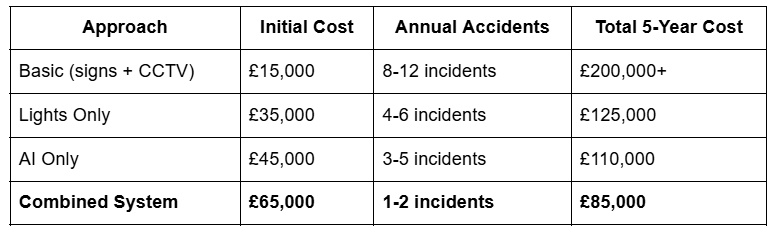
The combined approach costs less over time despite higher upfront investment. Plus HSE inspectors seeing integrated safety systems recognize serious safety commitment, not just box-ticking.
Use Cases in UK Warehouses
Real-world applications demonstrate where this technology creates measurable differences across various facility types.
Logistics Hubs: Birmingham, Hull, Manchester
The Hull warehouse mentioned earlier? This mid-sized logistics center averaged 3-4 reportable forklift incidents yearly. They installed integrated systems with AI cameras covering key areas plus blue spot and red zone lights on all forklifts.
Six-month results:
- 68% reduction in near-misses
- Only 1 minor accident (vs. 2-3 previously)
- 23% operational efficiency improvement
- Zero HSE improvement notices during inspection
Cold Storage Facilities
Cold storage presents unique challenges: condensation on visors, icy floors, bulky protective clothing limiting vision, reduced overall visibility. Smart warehouse surveillance combined with lighting becomes crucial here. AI cameras in heated, weatherproof enclosures monitor cold zones while lights create brilliant contrast against typically white/light environments.
Manufacturing Plants
Manufacturing environments feature the most complex forklift traffic patterns with multiple MHE types operating simultaneously. AI systems excel by tracking and identifying different vehicle types, recognizing that loaded counterbalance forklifts need more clearance than empty pallet jacks.
Hazardous Zones
Environments with explosion risks require explosion proof forklift camera systems. These ATEX-certified cameras and lights operate safely in potentially explosive atmospheres while maintaining full AI functionality.
Integration & Technology
Modern forklift AI safety systems communicate through IoT technology, creating integrated responses:
- AI camera detects potential danger
- Signal sent to central control
- Control system triggers appropriate lights
- Both systems log incidents
- Data stored for analysis
This happens in milliseconds. Most systems integrate with existing VMS, warehouse management systems, and fleet management platforms.
Automation Examples:
- Pedestrian detection triggers rapid-flash blue lights and audible alerts
- Excessive speed detection activates red warnings and supervisor notifications
- Blind spot warnings trigger directional lights showing exact hazard position
Compliance & UK Safety Standards
Meeting HSE forklift safety UK requirements becomes straightforward with integrated systems addressing workplace transport guidance, BS EN 1837 lighting standards, and ISO 45001 requirements.
HSE requires:
- Adequate visibility and lighting
- Pedestrian/vehicle separation where practical
- Warning systems where necessary
- Regular safety monitoring and review
Combined AI and lighting systems address all requirements while demonstrating proactive risk management. For hazardous environments, ATEX-certified equipment ensures HSE warehouse compliance with DSEAR regulations.
Future of Smart Warehouse Safety
Next-generation systems will feature AI predictive analytics identifying where accidents will likely happen before situations develop. Industry 4.0 integration will coordinate human-driven forklifts with AGVs, wearable technology, and real-time safety dashboards providing unprecedented visibility.
Advanced features coming soon include facial recognition for fatigue detection, heat mapping showing incident patterns, and predictive maintenance alerts. However, technology enhances rather than replaces human judgment, it works best combined with proper training, good safety culture, and worker input.
Conclusion
UK warehouses face real safety challenges that traditional approaches can't adequately address. The solution isn't choosing between AI cameras or safety lights, it's embracing both as comprehensive, integrated systems providing 360° coverage, proactive protection, genuine HSE compliance, and peace of mind.
The warehouses already using these systems see fewer accidents, better productivity, improved morale, and easier compliance. That Hull warehouse manager wished they'd implemented it years earlier.
Can you really afford NOT to invest in integrated forklift AI safety systems? The cost of even one serious accident far exceeds any technology investment. Every day you delay is another day operating with preventable risks.
Ready to Upgrade Your Warehouse Safety?
SharpEagle specializes in integrated solutions combining AI forklift CCTV systems with intelligent safety lighting. We've helped UK warehouses reduce accidents, improve compliance, and create genuinely safer environments.
Our solutions include AI CCTV with real-time hazard detection, complete safety light ranges, full integration capabilities, ATEX-certified options, and comprehensive support, all HSE-compliant and trusted by UK industries.
Contact SharpEagle today for a free safety assessment. We'll analyze your setup, identify improvements, and show exactly how integrated systems could transform your safety performance.
FAQs
Can AI CCTV automatically trigger forklift lights?
Absolutely! When AI cameras detect potential hazards like pedestrians entering danger zones, they automatically trigger safety lights to flash warning patterns within milliseconds through IoT connectivity. Different light patterns activate based on hazard types detected.
Are these solutions suitable for outdoor loading bays?
Yes, with weatherproof configurations (IP65+ ratings). Modern systems handle outdoor conditions, though bright daylight requires higher-intensity lights. Many UK warehouses successfully use these in covered bays and fully exposed yards.
How many AI cameras or lights are ideal for mid-sized warehouses?
A typical mid-sized warehouse (20,000-50,000 sq ft) needs 8-12 AI cameras focusing on high-traffic intersections and blind corners, plus lights on every active forklift. Best approach: start with professional assessment mapping accident hotspots, then prioritize coverage there first. What are the best forklift lighting options for warehouse safety?What are the best forklift lighting options for warehouse safety?
What are the best forklift lighting options for warehouse safety?
The most effective forklift lighting options for warehouses include blue spot safety lights, red zone lights, LED work lights, rear warning lights, and beacon/strobe lights. SharpEagle offers integrated forklift lighting solutions designed to reduce pedestrian collisions and improve visibility in high‑traffic warehouses.
