

Summary
Forklift-pedestrian collisions remain a critical warehouse safety challenge despite traditional measures. AI forklift safety cameras revolutionize accident prevention through real-time pedestrian detection, automated alerts, and predictive risk analysis. These intelligent systems reduce incidents by up to 50% across UK, UAE, and Saudi Arabia facilities through computer vision technology that actively identifies hazards and warns operators before collisions occur.The rise in forklift-pedestrian collisions across modern warehouses represents one of the most persistent and serious safety challenges facing industrial operations globally. Despite comprehensive training programs, floor marking, and traditional safety equipment, incidents continue at alarming rates. Statistics show that pedestrian strikes account for a significant portion of serious warehouse injuries, with consequences ranging from minor injuries to fatalities that devastate families and organizations.
UK: HSE guidelines increasingly emphasize pedestrian segregation and advanced safety technology implementation. Forklift safety solutions UK must address aging warehouse infrastructure and high-density operations across major logistics hubs.
UAE: Busy logistics facilities operate 24/7 supporting regional trade flows. The forklift pedestrian safety UAE challenges include extreme heat, multi-shift operations, and rapidly expanding industrial zones requiring scalable safety solutions.
Saudi Arabia: The Kingdom's Vision 2030 industrial expansion creates rapidly growing facilities where forklift pedestrian safety Saudi Arabia implementation must match ambitious operational growth while maintaining international safety standards.
The Core Problem: Limited Visibility and Human Error
Understanding why traditional approaches fail helps explain why AI technology delivers such dramatic improvements.
Blind Spots Created by Operational Realities:
Forklift design inherently creates massive visibility limitations. Elevated loads completely block forward vision. Counterweights eliminate rearward visibility. Mast structures obstruct side views during turns. Racking and stored inventory create additional visual obstacles throughout warehouse environments. The pedestrian detection forklift system must address these fundamental design limitations that no amount of operator training can overcome.
Pedestrian Awareness Gaps:
Workers focused on tasks often don't notice approaching forklifts despite warning beepers. Warehouse noise drowns out audible alerts. Complacency develops when workers become habituated to constant forklift presence. Temporary workers or visitors unfamiliar with facility layouts don't recognize danger zones. These human factors create situations where even careful operators cannot prevent accidents.
Manual Judgment Limitations:
Operators managing complex maneuvers—precise positioning, load balancing, speed control—cannot simultaneously monitor all potential pedestrian locations. Split-second decisions about whether pedestrians see the forklift often prove incorrect. Fatigue during extended shifts degrades decision-making and reaction times. The cognitive load of constant vigilance proves impossible to maintain consistently.
Lack of Predictive Capability:
Traditional systems are entirely reactive. Accidents must be fully developing before operators recognize dangers. No advance warning allows preventive action. Post-accident footage helps investigations but doesn't prevent incidents. This fundamental limitation makes traditional approaches inadequate for modern warehouse safety requirements.
What Are AI Forklift Safety Cameras?
Understanding the technology behind these intelligent systems reveals how they transform warehouse safety from reactive to proactive.
Smart AI forklift cameras use artificial intelligence and machine learning algorithms to detect humans instantly and automatically, distinguishing pedestrians from equipment, inventory, or other objects. These systems combine advanced computer vision, real-time processing, and automated alert mechanisms into integrated safety platforms.
Core Detection Capabilities:
Human Shape Recognition: Advanced algorithms trained on millions of images identify human forms regardless of clothing color, posture, or partial obstruction. Systems recognize pedestrians even when carrying objects or wearing bulky protective equipment.
Distance Estimation: Precise calculation of pedestrian proximity enables graduated warnings. Early alerts at safe distances, escalating alarms as risks increase. Exact distance measurement supports automatic speed reduction or braking in advanced systems.
Movement Prediction: AI analyzes pedestrian movement patterns predicting trajectory and potential collision risks. Systems distinguish between pedestrians safely positioned versus those moving into danger zones. Predictive capability provides warnings before situations fully develop.
System Types:
AI Obstacle and Human Detection Cameras: Specialized systems identifying both pedestrians and physical obstacles, providing comprehensive hazard awareness.
360° AI Vision Systems: Multiple synchronized cameras creating complete panoramic coverage eliminating all blind spots through intelligent image fusion.
AI Monitoring with In-Cabin Alerts: Real-time processing triggering visual dashboard warnings and audible alarms directly to operators during potential collision situations.
How AI Cameras Detect Pedestrians in Real Time
The technical process behind instant detection demonstrates why these systems dramatically outperform traditional approaches.
Deep-learning algorithms identify humans instantly even in challenging conditions where traditional cameras fail completely. The AI-based forklift monitoring maintains effectiveness in poor lighting during night shifts, busy environments with multiple moving objects, and obstructed areas where pedestrians are partially hidden behind inventory or equipment.
Detection Workflow:
Step 1: Continuous Environmental Scanning The forklift vision AI system constantly analyzes video feeds at 30-60 frames per second, monitoring all camera coverage areas simultaneously without attention lapses or fatigue.
Step 2: Pedestrian Identification Computer vision algorithms identify human shapes distinguishing them from forklifts, pallets, inventory, or infrastructure elements. Recognition works regardless of pedestrian clothing, posture, or carrying loads.
Step 3: Risk Calculation Systems analyze pedestrian distance, movement direction and speed, forklift trajectory and velocity, and predicted paths calculating collision probability within milliseconds.
Step 4: Automated Alert Activation When risks exceed threshold levels, the AI forklift warning system triggers immediate visual indicators on operator displays, audible alarms at escalating volumes, and optional automatic speed reduction or braking assistance.
Real-World Application Examples:
UK Cold Storage: Facilities with sub-zero temperatures where fogging and poor lighting create visibility challenges. AI thermal detection maintains pedestrian identification capability when visual systems struggle.
UAE Logistics Yards: 24/7 operations during night shifts across outdoor areas. AI systems maintain detection accuracy regardless of ambient lighting, supporting round-the-clock safe operations.
Saudi Manufacturing Floors: Dense foot traffic near assembly lines with constant worker presence. The automated pedestrian detection forklift capability manages complex environments where manual monitoring becomes impossible.
Key Features of AI Pedestrian Detection Systems
Understanding which capabilities deliver genuine safety improvements helps warehouse managers evaluate system options.
Real-Time Human Recognition: Instant identification without processing delays. Recognition works in 100-300 milliseconds—faster than human reaction time—providing protection before operators consciously register hazards.
Blind Spot Elimination: The forklift blind-spot cameras provide comprehensive coverage of areas operators cannot physically see. 360° sensor arrays ensure no genuine blind spots remain unmonitored.
Distance and Movement-Based Alerts: Graduated warning systems provide early gentle alerts at safe distances, escalating to urgent alarms as risks increase. Movement tracking predicts pedestrian trajectory enabling warnings before pedestrians fully enter danger zones.
Integration Capabilities: Seamless connection with telematics platforms for data logging and analytics, fleet management systems tracking safety performance, existing safety lighting for coordinated warnings, and building-wide monitoring for centralized safety management.
Environmental Durability:
Heat Resistance: UAE and Saudi Arabia facilities require systems maintaining performance in 50°C+ temperatures. Specialized cooling and thermal management ensure reliable operation despite extreme heat.
Cold Storage Compatibility: UK and GCC frozen facilities need equipment functioning in -30°C conditions. Anti-fog technology and low-temperature electronics prevent failures in sub-zero environments.
AI vs Traditional Camera Systems: The Critical Differences
Direct comparison reveals why upgrading to forklift AI collision prevention technology delivers transformative safety improvements.
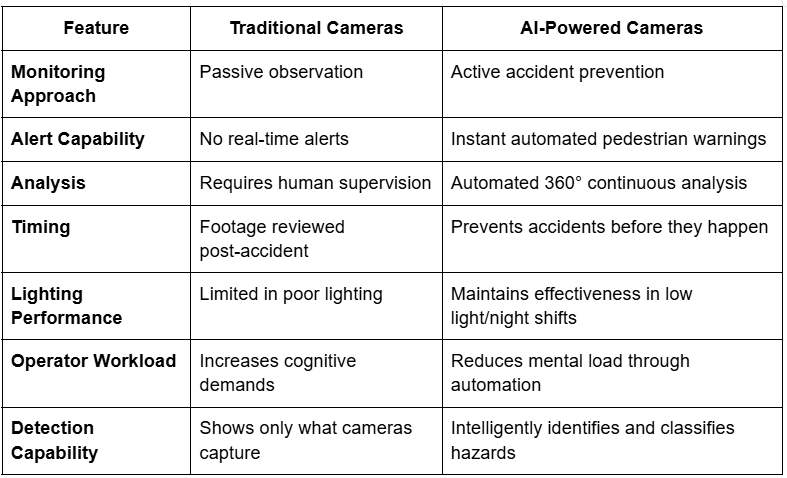
The fundamental difference: traditional cameras are information displays requiring constant operator attention. AI systems are intelligent safety partners actively protecting against collisions regardless of operator attention or awareness.
Real-World Use Cases Across Regions
Actual implementations demonstrate measurable improvements these systems deliver in diverse operational environments.
United Kingdom Implementation
A major logistics warehouse in Manchester implemented smart AI forklift cameras across their 20-forklift fleet operating in 180,000 square feet. Before installation, the facility averaged 6-8 pedestrian near-miss incidents monthly. After six months with AI detection, near-misses reduced by 50% to 3-4 monthly incidents. Zero serious collisions occurred versus their previous average of 1-2 annually. Operator confidence surveys showed 40% improvement in perceived safety. The facility achieved ROI in 16 months through reduced insurance premiums and avoided accident costs.
UAE Ports Application
Dubai port operations deployed AI pedestrian detection managing congested container terminals with 24/7 forklift operations. The challenging environment included mixed traffic with trucks, cranes, and hundreds of workers, variable lighting from harsh daytime sun to complete darkness, and saltwater exposure requiring specialized weatherproof systems. Results showed 60% reduction in close-call incidents during critical night-shift operations, improved workflow coordination during peak container movements, and successful HSE audit commendation for proactive safety technology adoption.
Saudi Arabia Industrial Expansion
A major Riyadh manufacturing facility integrated machine-learning forklift safety systems during their expansion supporting Vision 2030 industrial growth. The implementation addressed tight assembly line spacing with minimal clearances, high pedestrian density near production zones, and extreme temperature equipment performance demands. Outcomes included 55% reduction in human-machine interaction incidents, enhanced production efficiency through increased operator confidence, and successful compliance with international safety standards required for export partnerships.
Benefits of AI Cameras for Forklift Pedestrian Safety
Understanding comprehensive advantages helps justify investment while demonstrating value beyond accident prevention.
Dramatic Accident Reduction: Facilities implementing AI systems consistently report 40-60% reduction in pedestrian-forklift incidents. Real-time forklift pedestrian alerts prevent situations from developing into actual collisions.
Enhanced Operator Performance: Reduced cognitive load allows operators to focus on primary tasks. Increased confidence enables faster, more efficient operations. Lower stress improves job satisfaction and reduces turnover.
Improved Pedestrian Awareness: Visual and audible warnings create safer work environments. Workers gain confidence that technology provides backup protection. Enhanced safety culture improves overall facility operations.
Regulatory Compliance: Demonstrates serious commitment during HSE, ISO, or regional safety audits. Advanced technology implementation often results in reduced inspection frequency. Documentation capabilities support compliance reporting and incident investigation requirements.
Financial Returns: Lower insurance premiums through demonstrated safety improvements. Reduced compensation claims and legal exposure. Decreased equipment damage and downtime. Improved operational efficiency delivers measurable productivity gains.
Choosing the Right AI Forklift Safety System
Systematic evaluation ensures selected systems match specific operational requirements and deliver optimal protection.
Facility Assessment Considerations:
Warehouse Size and Traffic Flow: Large facilities require more extensive camera coverage and centralized monitoring. High-traffic operations benefit most from advanced AI detection and instant alerts.
Blind Spot Severity: Map specific blind spot locations throughout facilities. Prioritize camera placement in highest-risk areas. Consider 360° systems for comprehensive coverage versus targeted installations.
Forklift Fleet Characteristics: Verify system compatibility with specific equipment types—counterbalance, reach trucks, order pickers. Consider whether fleet standardization enables uniform system deployment.
Environmental Conditions: Cold storage demands anti-fog, low-temperature systems. Outdoor yards require weatherproof, heat-resistant equipment. Dusty environments need sealed housings and self-cleaning capabilities.
Integration Requirements: Evaluate compatibility with existing safety lighting, telematics platforms, and fleet management systems. Consider whether warehouse pedestrian safety AI should connect to building-wide monitoring infrastructure.
Installation and Maintenance Best Practices
Proper deployment and ongoing care ensure systems deliver optimal long-term performance.
Installation Essentials:
Strategic Camera Placement: Position cameras providing complete blind spot coverage. Mount at optimal heights and angles for pedestrian detection. Ensure coverage of high-risk areas like intersections and loading zones.
System Calibration: Configure AI algorithms for facility-specific conditions. Adjust detection sensitivity balancing accuracy against false alarms. Test thoroughly before full operational deployment.
Operator Training: Provide comprehensive instruction on alert interpretation and response. Explain system capabilities and limitations honestly. Emphasize that AI supplements rather than replaces situational awareness.
Ongoing Maintenance:
Weekly Tasks: Clean camera lenses preventing dust accumulation degrading detection. Verify all alerts function properly through test scenarios. Check mounting security and cable connections.
Monthly Diagnostics: Run comprehensive system tests validating detection accuracy. Review logged incidents identifying patterns or system issues. Update software maintaining optimal performance and latest capabilities.
Data Analysis: Analyze incident logs revealing high-risk areas or times. Use performance metrics demonstrating ROI and safety improvements. Adjust systems based on operational experience and changing conditions.
Conclusion
AI forklift safety cameras are transforming warehouse safety through intelligent technology that actively prevents accidents rather than passively recording them. These systems eliminate blind spots, predict collision risks, and provide automated warnings that save lives while improving operational efficiency.
Transform Your Warehouse Safety with AI Technology
Contact SharpEagle today for a free warehouse safety assessment. We'll evaluate your specific challenges and recommend customized AI systems delivering maximum pedestrian protection and operational ROI.
FAQs
How do AI Forklift cameras detect pedestrians around forklifts?
AI forklift cameras use computer vision algorithms trained on millions of images to identify human shapes in real-time. Deep learning technology analyzes video feeds 30-60 times per second, distinguishing pedestrians from equipment, inventory, or other objects. When pedestrians enter monitored zones, systems calculate distance and movement trajectory, determining collision risk within milliseconds. Upon detecting hazards, automated alerts trigger immediately through visual displays, audible warnings, and optional automatic speed reduction—all happening faster than human reaction time and maintaining effectiveness regardless of operator attention or awareness.
Are AI forklift cameras better than traditional CCTV cameras?
Yes, significantly. Traditional CCTV provides only passive video feeds requiring constant operator monitoring and interpretation. AI cameras actively detect pedestrians and automatically trigger warnings without requiring operator attention. Traditional systems are reactive—accidents must develop before operators notice. AI systems are proactive—predicting risks and providing warnings before dangerous situations fully form. Real-world data shows AI reduces incidents by 40-60% compared to traditional cameras showing only 15-20% improvement over no cameras. The difference is automation—AI catches hazards operators miss during complex operations.
Do AI pedestrian detection systems actually reduce forklift accidents?
Absolutely. Multiple case studies demonstrate 40-60% reduction in pedestrian-forklift incidents after AI implementation. UK facilities report near-misses dropping from 6-8 monthly to 3-4 following deployment. UAE port operations show 60% fewer close-calls during night shifts. Saudi manufacturing plants report 55% reduction in human-machine interaction incidents. These aren't theoretical benefits—they're measured outcomes from actual implementations. The effectiveness stems from instant automated detection working continuously without attention lapses, fatigue, or distraction affecting performance.