

Summary
This guide covers everything you need to know about the explosion proof mini IR camera, from ATEX certification and flamepath engineering to IR night vision and real-world deployment in oil, gas, chemical, and offshore environments. Learn how SharpEagle Technology's certified compact explosion proof cameras deliver reliable 24/7 surveillance in the most demanding hazardous zones while meeting global safety compliance standards.If you work in oil and gas, chemicals, or any industry where flammable gases are part of daily life, you already know that safety is not something you negotiate on. Surveillance in these environments is not just about security. It is about keeping people alive and operations running without incident.
The problem is that most cameras were never built for this. A standard CCTV camera installed in a Zone 1 classified area is not just a compliance failure. It is a genuine ignition risk. Internal sparks, heat from electronics, and unsealed enclosures can all contribute to a catastrophic outcome in a volatile atmosphere.
This is exactly why the demand for ATEX certified monitoring solutions has grown so sharply across industries worldwide. Facilities managers, safety engineers, and procurement teams are moving away from makeshift solutions and toward purpose-built equipment. The explosion proof mini IR camera sits at the center of this shift. It is compact enough for confined spaces, certified for the harshest zones, and capable of watching over your site around the clock without introducing new risks.
What Is an Explosion Proof Mini IR Camera?
At its core, an explosion proof mini IR camera is a certified surveillance device built to operate safely in environments where explosive gases, vapours, or dust may be present.
The explosion proof part means that if anything goes wrong internally, a spark or a component failure, the enclosure contains it. The housing is engineered with precision flamepath joints that cool any escaping gases before they can reach the outside atmosphere and ignite it. This is fundamentally different from a regular camera housing, which offers zero containment.
The mini part matters more than people often realise. Many hazardous areas such as pump rooms, equipment bays, and pipeline corridors simply do not have the space for a large industrial camera. A compact explosion proof mini IR camera can be positioned in locations where nothing else would fit, giving you coverage you would otherwise have to go without.
The IR element is what makes these cameras effective around the clock. Infrared illumination allows the camera to capture sharp footage in complete darkness without any visible light source. In a facility that operates 24 hours a day, that is not a bonus feature. It is a requirement.
SharpEagle Explosion Proof Mini IR Camera is a practical example of all three principles working together: a certified, stainless steel, compact body with built-in IR capability, designed specifically for the environments where standard cameras simply do not belong.
Why These Cameras Matter in Hazardous Environments
Think about what a confined industrial space actually looks like. Offshore pump rooms with barely enough clearance to work in. Underground tunnels where cables and pipework leave almost no wall space. Equipment bays on petrochemical sites where every fitting has been positioned with millimeter precision.
Getting surveillance into these spaces has historically been a significant challenge. Large explosion proof cameras can be impractical to mount, and routing cables in already congested areas adds further risk and cost. Small oil rig cameras and similar compact certified units exist precisely to solve this problem.
Beyond the physical constraints, there is the operational reality of 24/7 monitoring. These facilities never sleep, and neither should their surveillance. The IR night vision capability of a mini explosion proof camera means that low-light areas and overnight operations are covered without requiring separate lighting infrastructure.
Compliance and insurance are equally important drivers. Regulatory frameworks in most regions require certified equipment in classified zones. Insurance providers are increasingly specific about what equipment must be in place for coverage to be valid. Deploying explosion proof security cameras that carry the right ATEX or IECEx certification addresses both concerns directly.
And practically speaking, having eyes on your site continuously helps you catch problems early. A leak developing, a procedure not being followed, and equipment behaving abnormally. You see it before it becomes an incident.
How Explosion Proof Mini IR Cameras Work
The engineering behind these cameras is more thoughtful than it might appear from the outside.
The housing is designed around the concept of pressure containment and flamepath management. If an internal ignition event were to occur, the enclosure is built to withstand the pressure surge without failing. Any gases that do escape must travel through precisely machined narrow gaps in the flamepath joints. By the time they exit the housing, they have cooled below the ignition point of the surrounding atmosphere. The explosion has been contained.
The infrared system works through an array of IR LEDs positioned around the lens. These emit light at around 850 nm, completely invisible to the human eye but fully detectable by the camera sensor. The result is a clear greyscale image in conditions of total darkness. Heat management within the housing keeps LED and sensor temperatures within safe limits, which is critical in an environment where thermal risks are taken seriously.
Most explosion proof mini IR cameras use a fixed lens rather than a motorized one. This keeps the design simpler, eliminates moving parts that could eventually fail, and maintains stable, reliable framing of the monitored area. Video is typically encoded in H.264 with dual-stream output, which means you can record at full resolution locally while simultaneously streaming a lower-bandwidth feed to a remote control room.
Key Technical Features to Look For
Not all explosion proof cameras are equal, and knowing what to look for saves time and avoids costly mistakes.
Certification is the non-negotiable starting point. Any camera intended for a classified hazardous zone must carry valid ATEX or IECEx certification, clearly specifying the zone it is rated for. No certification means no installation.
Build quality determines how long the camera will survive in the field. Stainless steel construction is the right choice for corrosive environments, including refineries, offshore platforms, and chemical plants. An IP68 rating confirms the enclosure is fully sealed against dust and water, including continuous immersion.
Imaging performance needs to be matched to the task. A minimum of 1080p HD resolution is the baseline for modern industrial surveillance. An IR range between 15 and 25 meters suits most confined space applications. If your monitoring zone is larger, that needs to be factored into the specification from the start.
Electrical compatibility is a practical consideration that is easy to overlook. A DC 12V power requirement simplifies integration with standard industrial supply systems. Low power consumption reduces heat output within the enclosure, which matters in tight spaces.
Installation flexibility is where the mini form factor pays off. A compact footprint combined with support for wall, ceiling, and pole mounting means the camera can go where coverage is needed, not just where it is convenient.
SharpEagle's Explosion Proof Mini IR Camera meets all of these benchmarks. ATEX certified, IP68 rated, HD imaging, stainless steel construction, and a compact design built for the spaces that present the greatest challenge. Take a look at the product range and measure it against your site requirements.
Key Benefits of Ex-proof Mini IR Camera
The advantages of getting this right go beyond ticking a compliance box.
Safe, continuous operation in explosive atmospheres is the obvious one. These cameras are built to be there, running reliably, without introducing any additional risk to the environment.
Clear night vision without separate lighting infrastructure reduces installation complexity and ongoing energy costs. You get the coverage without the additional overhead.
The compact design opens up monitoring possibilities that simply were not available before. Areas that have historically been blind spots on surveillance plans can now be covered properly.
Fewer moving parts and industrial-grade materials mean lower maintenance requirements and less downtime over the life of the equipment. When you factor in the cost of maintenance visits to hazardous zones, that saving is meaningful.
Industrial Applications and Use Cases
Oil and Gas: Refineries, pipeline networks, and offshore valve stations are among the highest-risk surveillance environments in existence. Small oil rig cameras and compact explosion proof units are routinely installed to monitor equipment, detect leaks, and document operational compliance. The IR capability is particularly valuable on production platforms where large sections of the facility operate with minimal artificial lighting at night.
Chemical and Petrochemical Plants: Reaction zones and solvent storage areas require cameras that can withstand aggressive chemical vapors while maintaining image quality. ATEX zone 1 camera certification ensures the equipment is rated for areas where explosive concentrations may be present during normal operations, not just fault conditions.
Marine and Offshore Platforms: Salt air, constant humidity, and physical vibration make offshore environments exceptionally demanding. Corrosion-resistant stainless steel housings with IP68 protection handle these compounded stresses. Small oil cameras designed for marine deployment need to survive long-term in conditions that would destroy general-purpose equipment within months.
Power Plants and Fuel Storage: Continuous monitoring of fuel storage areas and generation plant equipment supports both safety and operational oversight. The explosion proof IR camera's night vision capability ensures that surveillance does not drop off during overnight hours when incident detection is equally important.
Confined Hazardous Spaces: Tunnels, pump rooms, and enclosed equipment bays are the environments where the compact form factor of a mini explosion proof camera for oil and gas applications makes the greatest difference. These are the locations that larger cameras simply cannot reach.
Mini IR Camera vs Zoom IR Camera: Which Should You Choose?
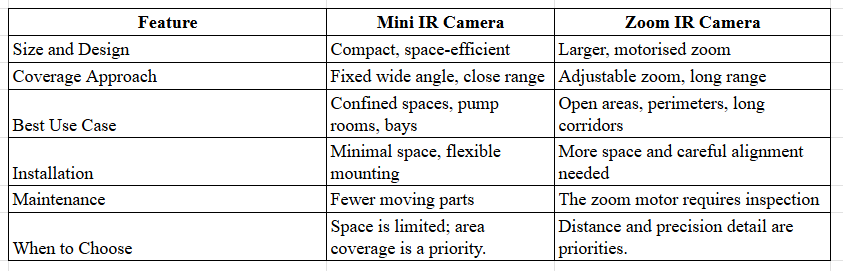
The simple rule is this: if you need to monitor a confined or complex space reliably, the mini IR camera is the right choice. If you need to cover distance or zoom into detail across an open area, the zoom camera earns its place. Many facilities use both in a complementary configuration.
Installation Best Practices
Start with a proper site assessment. Before any camera is specified, a qualified engineer should confirm the zone classification, identify the gas or dust group present, and determine the temperature class required for installed equipment. Getting this wrong at the planning stage creates problems that are expensive to fix once equipment is already on site.
Position cameras to prioritise coverage of high-risk areas such as equipment access points, process control panels, valve clusters, and personnel transit routes. Elevated mounting reduces blind spots and keeps the camera away from direct impact or splash risks.
Cable routing in hazardous areas must follow the applicable installation standard precisely. Certified cable glands are not optional, and conduit sealing at required intervals prevents flammable gases from migrating through the conduit network into safe areas or electrical enclosures.
Commission properly. Verify the field of view for each camera against the original coverage plan, address any blind spots before sign-off, and confirm that every camera is recording reliably and integrated with the control room system before the installation is considered complete.
Maintenance and Lifecycle Management
Routine inspection keeps explosion proof cameras performing safely over their operational life. Check the enclosure for physical damage, corrosion, and seal integrity at regular intervals. Verify that cable glands remain tight. Any camera with enclosure damage should be taken out of service immediately.
Clean lens ports and external surfaces using approved cleaning agents only. Abrasives scratch both the optics and the corrosion-resistant coating.
Apply firmware updates according to manufacturer guidance to maintain cybersecurity integrity and system compatibility. A well-maintained industrial explosion proof camera, operating within its rated conditions, can deliver reliable performance for well over a decade. That makes the initial investment in certified equipment look very sensible over the long term.
Compliance, Certifications and Standards
ATEX directives are the governing framework for equipment used in explosive atmospheres across European and Middle Eastern markets. IECEx provides an internationally recognised equivalent certification. Both systems classify hazardous areas into zones based on how frequently an explosive atmosphere may be present.
Zone 1 covers areas where explosive gas atmospheres are likely during normal operations. Zone 2 applies where they occur only under abnormal conditions. Zone 21 and Zone 22 apply the same logic to combustible dust environments. An ATEX zone 1 camera must be rated for the highest-risk classification to be legally deployed in Zone 1 areas.
During audits and insurance reviews, operators must produce valid certification documentation for every electrical device in a classified zone. Missing or incorrect certification is one of the most common audit findings and can result in enforcement action, insurance complications, or operational shutdown.
How to Choose the Right Camera
A structured checklist makes the selection process much more straightforward:
- Zone compatibility: Does the camera's ATEX or IECEx certification match the zone classification of your installation location?
- IR range: Does the infrared range cover the monitoring area you need?
- Material suitability: Is the housing material appropriate for the chemicals, humidity, and temperatures at your site?
- Environmental conditions: Does the camera's operating temperature range and IP rating match your site profile?
- Resolution: Is the imaging specification sufficient for what you need to see, whether for personnel identification, equipment labeling, or general area awareness?
- Integration: Can the camera connect to your existing recording and monitoring infrastructure without major modifications?
When selecting a reliable solution, consider SharpEagle Technology for certified, industry-proven explosion proof cameras tailored to hazardous environments.
Conclusion
The explosion proof mini IR camera is not a niche product for edge cases. It is an increasingly central piece of safety infrastructure for any facility that operates in classified hazardous zones. As regulatory requirements tighten and the consequences of non-compliance become more serious, the question is less about whether you need this and more about how quickly you can get it right.
Compact IR technology has removed the excuse that some spaces are too difficult to monitor. Every corner of a hazardous facility can now have reliable, certified surveillance, reducing incident risk, supporting compliance, and giving operators the visibility they need to manage their sites with confidence.
Safety combined with visibility is what operational excellence actually looks like in practice.
Ensure safety without compromise. Explore SharpEagle Technology's Explosion Proof Mini IR Camera and discover how certified surveillance can transform your hazardous area operations.
Contact us today for a consultation or a custom solution tailored to your facility.
SharpEagle Technology proudly serves clients across the UK and is expanding globally to bring certified hazardous area surveillance to industries worldwide.
