

- United Kingdom
- Conclusion: Install the Finest Safety Lights from the house of SharpEagle
- How SharpEagle Builds Its Forklift Safety Lights
- Are forklift safety lights required by OSHA?
- Are lights mandatory on forklifts in the UK?
- What lighting level should a UK forklift area have?
- Is there such a thing as an HSE approved forklift light?
- When should forklift safety lights be used?
- Do forklifts need warning lights in warehouses?
- What is the OSHA General Duty Clause?
- Can lack of forklift lighting lead to OSHA violations?
Summary
This blog explains OSHA requirements for forklift safety lights, highlighting that while specific lights like Blue and red warning lights are not named in any UK regulation. What PUWER 1998 does require is that you control the risk, and the risk assessment you carry out under the Management of Health and Safety at Work Regulations 1999 is what decides whether a light is needed on a given truck and route. It covers key standards such as minimum illumination levels, mandatory headlights in low-light conditions, and the role of warning systems. Widely applicable across the UK, these guidelines help businesses improve safety, reduce accidents, and ensure compliance with global standards. Forklifts can be dangerous, so OSHA has rules to keep workers safe. When lighting is low, forklifts must use headlights to help drivers see better. In busy areas with many people, tail and brake lights should be used to avoid accidents. Forklifts also need horns and lights if needed for safety. Different safety lights like red warning lights, blue spotlights, and strobes help protect workers and pedestrians. Using these lights improves safety and helps prevent accidents at work.
The latest NSC data reveals that Forklifts caused 70 deaths in 2021 and 7,290 fatal injuries in 2020. These numbers indicate the urgent need to take safety measures in the workplace.
Safety lights have become a significant forklift safety solution in recent times. Many industries use the appropriate safety lights to enhance safety and help the operators work more effectively. However, whether or not the Occupational Safety and Health Administration mandates the use of forklift safety lights has still been a common question for many of our clients. Keep reading to find out what PUWER 1998 and HSE's ACOP L117 actually require on a UK site, and where a safety light is expected rather than mandated.
Forklift safety is a critical concern in industrial environments across the United Kingdom, where high traffic, limited visibility, and shared workspaces increase the risk of accidents. One of the most common questions businesses ask is: Are forklift safety lights required by OSHA?
The answer is not as straightforward as it seems. While the Occupational Safety and Health Administration (OSHA) sets clear standards for forklift operation and workplace safety, it does not always mandate specific lighting devices like blue or red safety lights. Instead, OSHA focuses on visibility, hazard prevention, and safe working conditions.
Understanding these requirements helps businesses stay compliant while implementing the right safety solutions to prevent accidents.
We understand that installing safety lights is a crucial decision for any organisation employing forklifts. Forklift safety lights contribute to enhanced safety for operators and pedestrians. Hence, we will delve into OSHA guidelines for forklift safety lights and explore various types of safety lights that contribute to a safer work environment.
Forklift Safety Light Guidelines by OSHA
OSHA– Occupational Safety & Health Administration aims to ensure employees' safe and healthy working conditions. It has enforced some safety regulations about the use of forklifts. There are three significant guidelines related to safety lights by OSHA.
1. Headlights Usage
Osha regulation 1910.178(h)(2) states that you must use headlights when the ambient lighting in the workspace falls below 2 lumens per square foot. This is particularly crucial during nighttime operations or when traffic obstructs visibility. Adequate illumination increases the operator's productivity and addresses operators' varying visibility needs, with older individuals requiring more light for optimal safety.
Maintain forklift safety compliance as per the guidelines to avoid penalties.
2. Tail/Brake Lights
Tail/brake lights, often integral to forklifts, are another requirement under OSHA's forklift safety rules. Tail/Brake lights enhance visibility, reducing the risk of forklift accidents in busy work environments. While not mandatory for forklifts operating in less crowded areas, OSHA recommends installing them in traffic areas with significant pedestrians.
3. Horns and Lights
ACOP L117 paragraph 122 lists audible warning devices such as automatic reversing bleepers, and flashing warning beacons, among the measures used to protect pedestrians. PUWER 1998 regulation 4 then requires the equipment you choose to be suitable for the conditions it is actually used in. This ensures the necessary audible and visual warnings are available to prevent potential hazards.
Apart from headlights and tail/brake lights, there are other types of forklift safety lights that you must use for enhanced safety. In the next section, we will discuss the types of forklift safety lights you can use to prioritize safety at your workplace.
Types of Forklift Safety Lights
Depending on your requirements, you can use different types of forklift safety lights to prevent accidents caused by forklifts. These lights protect operators and serve as adequate warnings for nearby pedestrians.
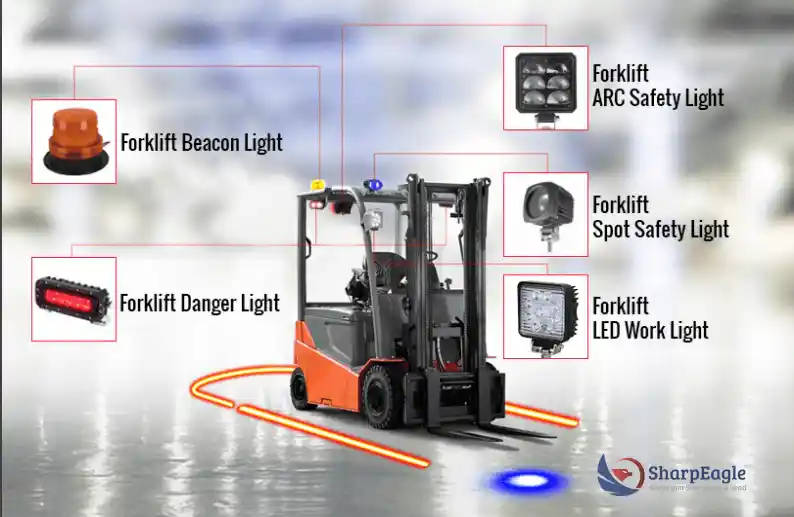
• Red Line Safety Light: The red colour is associated with a warning. Hence, The red forklift safety light creates a warning zone around the forklift, signalling the pedestrians about a restricted area when the forklift is in motion. It surrounds the area up to the mark where people must not enter. This visual cue aids in preventing unauthorized entry into potentially hazardous zones.
• Blue Spot Light: A blue safety light serves a dual purpose by helping operators identify roadblocks on their path and warning pedestrians about the forklift's movement. However, blue spot forklift safety lights are less effective than red safety lights for warning pedestrians from entering restricted areas. Hence, we suggest identifying your requirements and employing different safety lights to serve each purpose. Taking such safety measures will demonstrate corporate social responsibility and build stakeholder trust.
• Strobe light: The intensity of the beam in strobe lights is very high. Hence, it is highly efficient in drawing the attention of pedestrians and bypassers towards the forklift. Careful placement of the light ensures that workers and pedestrians know that the forklift is operating and they can stay clear of it.
• Arc Safety Light: Arc safety light is a multipurpose touch light made of a polycarbonate lens. This forklift safety lighting comes with casting aluminium alloy housing and double-insulated silicon rubberized wire for efficient working in low & high temperatures. You can also use this light for working in low & high temperatures. The tempered glass cover protects the system from external damage and is 100% dust, water, and earthquake-resistant.
As mentioned earlier, OSHA guidelines emphasize using these forklift safety lights to make your workplace safety-compliant. We often recommend it to our clients if the lighting conditions are deficient and need enhanced visibility.
By improving the operator's visibility, these lights protect workers and pedestrians from forklift accidents.
What UK Warehouse Operators Have to Get Right
United Kingdom
The UK follows strict workplace safety regulations aligned with HSE standards.
Forklift lighting solutions help:
- Improve compliance with visibility requirements
- Reduce accidents in narrow warehouse aisles
- Enhance pedestrian safety in shared spaces
- Support structured safety systems
In the UK, compliance + space constraints make safety lighting essential.
Conclusion: Install the Finest Safety Lights from the house of SharpEagle
We recognize the importance of prioritizing safety at a worksite where workers are always at risk of accidents and even deaths in some cases. Hence, we do rigorous site inspections and suggest robust safety measures that you should take to make your workplace safety-compliant.
We understand your commitment towards safety and fostering a culture of safety within the workplace. As a result, we suggest the best safety solutions depending on the nature of your work site.
How SharpEagle Builds Its Forklift Safety Lights
Our red zone, blue spot and arc lights are built to the safety norms OSHA sets for powered industrial trucks under 29 CFR 1910.178, and they are supplied for use on Great Britain sites where the duties sit with the employer under PUWER 1998 and HSE's ACOP L117. Every unit carries a stated IP rating and a declaration of conformity, which we will send you on request.
Contact our experts today to enhance the safety of your worksite. Let’s safeguard your workers and assets and create a safe workplace today.
FAQS
Are forklift safety lights required by OSHA?
OSHA does not specifically require safety lights like blue or red warning lights on forklifts. However, it does require employers to maintain a safe work environment and reduce hazards. If safety lights help prevent risks such as pedestrian collisions or poor visibility, they may be considered necessary under OSHA’s General Duty Clause.
Are lights mandatory on forklifts in the UK?
No regulation names a specific lamp. PUWER 1998 regulation 21 requires suitable and sufficient lighting wherever work equipment is used, and HSE's ACOP L117 paragraph 115 says a truck driven at night, or in areas with insufficient light such as drive-in racking, should have suitable lights at the front and rear.
What lighting level should a UK forklift area have?
HSE guidance HSG38 sets 20 lux average and 5 lux minimum for general movement of people, machines and vehicles, rising to 50 lux average and 20 lux minimum in hazardous areas and loading bays. Measure at floor level, not at the fitting.
Is there such a thing as an HSE approved forklift light?
No. HSE does not approve or certify products. What matters in Great Britain is that the light carries UKCA or CE marking with a stated IP rating, and that fitting it does not take the truck outside BS EN 1175 or BS EN ISO 3691-1.
When should forklift safety lights be used?
Forklift safety lights should be used in environments with high pedestrian traffic, blind spots, poor lighting, or noisy conditions where audible warnings may not be effective. In such situations, visual warning systems significantly improve safety.
Do forklifts need warning lights in warehouses?
While not always mandatory, warning lights are highly recommended in warehouses where forklifts and pedestrians operate together. They help create awareness and reduce the chances of collisions, especially in busy or confined spaces.
What is the OSHA General Duty Clause?
The General Duty Clause requires employers to provide a workplace free from recognized hazards that can cause serious harm. Even if a specific safety device is not mandated, employers must implement solutions—like safety lights—if they reduce known risks.
Can lack of forklift lighting lead to OSHA violations?
Yes, if poor lighting contributes to unsafe working conditions or accidents, it can lead to violations. Employers are responsible for ensuring proper visibility and hazard prevention, even if specific lighting equipment is not explicitly required.
