

Summary
Forklift safety lights help prevent warehouse accidents by warning pedestrians of approaching forklifts and highlighting danger zones. This guide explores blue spotlights, red zone lights, and other warning systems, explaining where they work best, from narrow aisles and loading bays to pedestrian crossings, cold stores, and outdoor yards. It also covers installation, durability, maintenance, running costs, and UK safety requirements. Learn how choosing and positioning the right forklift safety lights can improve visibility, reduce collision risks, and create a safer working environment.
Forklift safety lights project a coloured beam onto the warehouse floor to warn pedestrians that a truck is approaching, or to mark a keep-out zone around it. A common setup is a blue spot for approach warning and a red line for the exclusion boundary, fitted front and rear on the truck.
Warehouse environments are fast-moving, high-risk spaces where forklifts and pedestrians work side by side. Limited visibility, blind spots and noise make accidents more likely, especially in busy logistics hubs. Across UK warehouses and logistics hubs, forklift lights are becoming a standard safety upgrade.
HSE recorded 126 workers killed in work-related accidents in Great Britain in 2025/26 (provisional figures), and 24 of them were struck by a moving vehicle.
What do forklift safety lights actually do in a warehouse?
Forklift safety lights cast a coloured beam on the floor around the truck so that pedestrians get a visible warning zone they can see from a distance. This matters most at blind corners and busy junctions, where sound alone is often not enough to warn someone in time.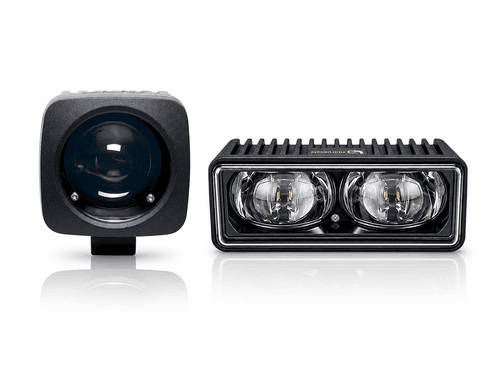 Generally, forklifts are designed in such a way that they are not ergonomically flexible, which is why they have a large turning radius. That makes them vulnerable to collision with pedestrians or other approaching vehicles. Forklifts can run into workers who remain busy in their work or are not paying attention to their surroundings, so it becomes very important to make sure workers keep a safe distance from the forklift. Here safety LED lights come into the picture. By mounting a red zone forklift safety lighting system on forklifts, the truck projects a red or blue line onto the floor, creating a safe, visible zone around the forklift, so that pedestrians can comprehend the unseen manoeuvre and distance themselves well in advance. This also helps warn pedestrians about nearby moving vehicles and other workplace hazards. Even if employees are busy with their work or absorbed in their phones, they can notice the bright light coming in their direction.
Read More: How to Enhance Loading Dock Safety with Forklift Light Systems
How hard are forklift safety lights to fit?
Fitting is straightforward on most trucks. Many overhead guards have pre-drilled holes, and drill-free brackets are available for trucks that don't. Our step-by-step guide to fitting forklift safety lights covers bracket choice, mounting height, beam aiming and wiring to the direction of travel.
How to choose forklift safety lights for a warehouse
Start choosing forklift safety light solutions by matching the light to the risk you are managing. A blue spot warns pedestrians of an approaching truck, and a red line marks a boundary they shouldn't cross. Then pick a build tough enough to survive daily knocks in a working warehouse. Get those three right and the rest is fine tuning.
- Type of light. Blue spotlights warn pedestrians of an approaching forklift, while red zone lights mark safe working boundaries. Many sites use a combination. Blue holds up well under normal warehouse lighting, while red reads more clearly as a hazard warning.
- Intensity and beam coverage. Adjustable LED intensity adapts to different warehouse conditions without causing glare. Beam angle and coverage matter more across large sites than small, tightly packed ones.
- Durability and build. Pick impact-resistant polycarbonate or aluminium housing that can handle dust, moisture and vibration. It costs more upfront but cuts maintenance over time.
- Installation and maintenance. Plug-and-play designs reduce fitting downtime. Replaceable components mean one failed part doesn't mean a full replacement.
- Compliance. Either UKCA or CE marking is accepted in Great Britain: the government announced in August 2023 that it would extend CE marking recognition indefinitely. Ask the supplier for a Declaration of Conformity, the IP rating and a vibration and shock figure.
- Compatibility. Not all lights fit every forklift model. Check mounting points before ordering. Universal brackets simplify things across a mixed fleet.
Each light type solves a different problem, so fitting the wrong one leaves a gap in the warning. An arc light marks the rear sweep, a blue spot warns of approach, a red line fixes a boundary, and a laser guide helps with placement at height. Our breakdown of the 7 types of forklift warning lights explains what each one does and where it belongs.
Where to fit forklift safety lights in a warehouse, zone by zone
Getting warehouse forklift safety right comes down to matching the light to the layout, not fitting the same setup on every truck regardless of where it works.
Narrow aisle and VNA racking
Blind corners at the end of every single aisle are the main risk here, mainly because a pedestrian stepping out will have no warning until the truck is already on top of them.
A blue spot mounted at both ends of the truck beats an aisle mirror, since a mirror only helps someone who's already looking at it, while a projected light catches attention from any angle. In narrow aisle work, check that a red zone line has room to land before fitting one, because the aisle width limits where the line can fall.
Loading bay and dock
Reversing into a trailer is where many dock incidents happen, and lights need to work alongside the site's existing dock traffic light system instead of competing with it. Our guide to loading dock safety with forklift light systems covers the dock side in more detail.
Trailer creep, where a trailer shifts slightly during loading, adds a moving risk that a fixed light alone won't catch. So this is one area where lights support, instead of replacing, a proper dock procedure.
Cross-aisle junctions and pedestrian crossings
A red zone line works best here, always alongside floor markings, not instead of them. Warehouse safety lights give a moving, attention-grabbing warning that static paint can't, but the painted crossing still tells people exactly where to stand once they've stopped. Running both together covers the gap either one leaves on its own.
Junctions are where the red and blue decision actually matters. A blue spot gives pedestrians warning that something is coming round the corner, while a red line tells them how far back to stand once it arrives. Our guide comparing red zone and blue spot lights sets out which combination suits aisle widths, dock areas and open yards.
Cold store and chiller
Condensation on the lens is a real problem in these zones, and it's why IP rating and operating temperature range matter more here than raw brightness.
A light that's bright but not rated for the temperature swing between a chiller and the rest of the warehouse will fog or fail faster than one built for it.
Outdoor yard
Daylight washes out a blue spot fast, so a beam that works perfectly indoors can be almost invisible in a yard by mid-morning. This is where it's worth switching to an amber beacon instead, since it holds up against ambient light in a way a projected spot doesn't.
How tough are forklift safety lights? Build, IP rating and lifespan
Think of lights and we start to imagine that they are always flimsy and delicate. But forklift safety lights do not use the fragile glass coverings found in incandescent, fluorescent and metal-halide lamps. SharpEagle's red line light is rated at 50,000 hours and the blue spot at 30,000 hours. On one eight-hour shift, five days a week, 50,000 hours is roughly 25 years of running.
The lighting system often comes with cast aluminium alloy housing and double-insulated silicone rubberised cable, built to handle the vibration and knocks of daily warehouse use. SharpEagle's units run on a 10V to 80V DC input, which covers the common forklift battery voltages from 12V to 80V, and they are rated to work from -40°C to 80°C, so cold store conditions and a hot yard in summer are both covered.
Some are covered with tempered glass for protection against external damage, and the better units carry an IP67 rating, which means they are dust-tight and can survive 30 minutes under a metre of water, not just splashes. An IP rating says nothing about impact, so ask separately for a vibration and shock figure.
What do forklift safety lights cost to run?
LED lights use far less power than other lighting sources, which keeps forklift operations efficient. They light up instantly, with zero downtime and consistent performance across forklift operations.
SharpEagle's blue spot runs on a single 3W LED, and the red zone line uses six 3W LEDs, around 18W in total. Run two units on a truck across an eight-hour shift and the combined draw is small enough that most fleets do not notice it against the truck's overall battery use, especially when compared with running cab lighting or a beacon. Where it adds up is over a full week of multi-shift operation, and that's where LEDs pull ahead of halogen. Halogen work lamp bulbs are typically rated at anywhere from a few hundred hours to about 2,000 hours, while an LED forklift light will run for 30,000 to 50,000 hours before it needs changing out. Over the life of a fleet, that difference removes a recurring maintenance job rather than just cutting the electricity bill.
Forklift safety lights, including arc safety lights, are also a good choice for industries working toward sustainable development, as longer-lasting lights mean fewer units thrown away over the life of a fleet.
Are forklift safety lights a legal requirement in a UK warehouse?
No. No UK regulation names forklift warning lights specifically, so there's no single rule that says a truck must carry one. What does apply is a set of broader duties that, in practice, point most sites toward fitting them anyway.
Regulation 17 of the Workplace (Health, Safety and Welfare) Regulations 1992 requires every workplace to be organised so that pedestrians and vehicles can circulate safely. PUWER 1998 regulation 21 requires suitable and sufficient lighting wherever work equipment is used. HSE's workplace transport guidance, including HSG136, A guide to workplace transport safety, says pedestrians and vehicles should have separate routes where possible, and HSE notes that vehicle-based aids can help where segregation can't be guaranteed. ACOP L117, which covers rider-operated lift trucks, sits alongside this and includes guidance on operator training. BS EN 1175:2025 sets the electrical requirements for the truck's own installation. It is not a standard for add-on lamps, but fitting a light should not compromise the truck's conformity, so check the wiring with the truck manufacturer or your service provider.
So none of this adds up to a legal mandate for lights by name. But where a workplace transport risk assessment identifies pedestrian exposure, and most warehouses will, warning lights move from a nice-to-have to an expected control measure.
Get Forklift Safety Lights and Demonstrate a Commitment to Safety
SharpEagle's aim is to help businesses and industries stay as productive and as safe as possible. We provide a range of forklift safety lights, like ArcLight, red danger lights, laser warning systems, beacon options and blue spot lights, all designed to boost efficiency and reduce site incidents. Check our full range of forklift safety lighting solutions or get in touch if you would like help choosing the right setup for your site.
