

Red and blue forklift safety lights do two different jobs. A blue spot projects a bright pool of light onto the floor three to five metres ahead of or behind the truck, warning that a forklift is approaching. A red line or zone light projects a boundary along the sides, marking the keep-out distance while the truck is moving. Most UK sites run both.
HSE recorded 126 worker deaths in Great Britain in 2025/26, and 24 of them came from being struck by a moving vehicle (figures are provisional). HSE also puts lift trucks at around a quarter of all workplace transport accidents.
Forklift Blue Spot Light: Warning Distance Along With Mounting Height
Forklifts are a primary cause of workplace accidents including forklift overturns, collisions, falling loads as well pedestrian accidents and more. Several reasons can contribute to these accidents like:
- Operator's inability to spot approaching intersection
- Visual inaccessibility due to forklift's blindspots
- Lack of proper monitoring as well as safety compliance
- Inadequate forklift maintenance
Forklift blue safety lights deal with the first two causes. They warn people at intersections and in the truck's blind spots before the truck reaches them.
At 5 mph site speed limit that gives roughly one to 2 seconds of warning before truck arrives at 10mph it's closer to 1 second. These lights also alert pedestrians and other drivers to get out of way when forklift operator is driving in reverse.
Features of Blue Safety Lights:
Casting Aluminium Alloy Housing
Forklift blue safety lights have very robust casting aluminium alloy housing which help shield delicate electronic parts of blue safety light from external impacts as well as vibrations, moisture and other environmental hazards. This aluminium casting also ensure optimal heat dissipation and guaranteed longevity and corrosion resistance keeping your lights functional and shining brightly through toughest industrial settings.
Tempered Glass Cover
A tempered glass cover makes forklift blue lights resilient and durable and heat resistant. It adds one extra layer of protection to ensure your light remain functional under harsh and extreme industrial environments. In case of breakages tempered glass breaks into small and blunt pieces instead of having sharp shards reducing risk of injuries.
High Power LED
Our forklift blue spot light uses a 3W high-power Osram LED running on 10V to 80V DC. It puts around 900 lux on the floor at 5 metres and is rated for 30,000 hours, so the spot stays bright on warehouse, logistics and manufacturing floors. Areas zoned for explosive atmospheres need a light certified for that zone.
IP-67 Rating
IP rating stands for Ingress Protection which rates protectiveness of electric device against dust and water. Our forklift blue safety lights have very impressive IP rating of 67 denoting high protection against solids (dust, dirt and particulates) and water when immersed up to 1 metre.
Where site needs direction of travel made obvious as well as presence of the truck blue arrow light projects chevron instead of spot, at the cost of narrower warning area.
Forklift Red Zone Light: What It Does And Where To Fit It?
To keep workers safe and to avoid forklift accidents occur due to forklift turnovers involving workers it is very important to establish and communicate correct distance that crew needs to maintain from forklifts. Red forklift safety lights can help you communicate safe distances and other safety protocols enhancing workplace safety.
Forklift red lights are most often attached to sides of vehicle to indicate safe distance between pedestrian as well as forklift. The red light they emit is also called halo zone and marks 0.6 to 1.5 metre boundary that no one should cross. This distance can be adjusted by angling light according to your facility space situation.
Features that make red forklift safety lights more effective:
Aluminium diecast housing with polycarbonate cover
The red safety lights aluminium diecast housing has robust foundation that enables heat dissipation to keep lights cool even during prolonged usage. This aluminium casting provides durability and resistance to impacts as well as vibrations and harsh environmental conditions. The polycarbonate cover offers excellent optical clarity and protection against dust and debris and minor impacts. These two features create functional and reliable safety light system capable of handling rigorous and harsh industrial conditions with IP67 rating protecting against dust and water immersion.
Stainless steel bracket
With stainless steel bracket, these red safety lights offer steadfast mounting support, ensuring secure attachment to forklift. This feature guarantees stability and reliability most needed essential for safety of operators and workers in industrial settings.
10V to 80V DC operating voltage
The light runs on anything from 10V to 80V DC, which covers the common forklift electrical systems from 12V and 24V up to 48V and 80V. One model fits a mixed fleet, which keeps spares and fitting simple.
High power Osram LED 6pcs*3w with 18W LED power
This indicates configuration and power rating of LED lighting system which is six individual LEDs each rated at 3 watts providing 18 watt LED Power typical for red zone units. The highpower LED enables bright illumination allowing you to use red forklift safety lights even in extreme low light conditions. This light is preferred in industries such as commercial and retail as well as industrial and manufacturing and automotive, among others.
Arc lights sit outside red and blue system but often run alongside it. They project wide bar of light across floor at side of truck marking the sweep of the rear end as it turns which is movement pedestrians misjudge very often. If you are deciding on full combination rather than that of just red and blue our guide to the 7 types of forklift warning lights covers arc and laser and beacon units side by side.
How do you install red and blue safety lights?
To know complete installation of Red & Blue Safety Lights for your warehouse or manufacturing plant follow our step by step manual
- Put double-sided tape on bracket's foot. This will reduce both tremors and prevent lights from rattling.
- Position light close to rear of head guard. Ensure operator can get in and out of seat without running into headlight.
- Set red zone light feet in place by encircling overhead guard with the two clamps.
- Using socket wrench or screwdriver to tighten clamps.
- Remove excess material from clamp strap.
- Place plastic clamp end piece over strap's sharp end to prevent sharp edges.
- Connect the wire and then use electrical tape to seal connection.
- As needed wire into forklift. The light can accept voltages from 10 to 80V DC.
- Angle each light before tightening: red zone lines 0.6 to 1.5 metres from the side of the truck, blue spots 3 to 5 metres ahead of or behind it. Then tighten the adjuster fully so vibration cannot shift the angle.
Getting the beam to land in the right place matters as much as the unit you buy: too high and the spot washes out, too low and it appears under the truck rather than ahead of it. Our step by step guide on how to fit a blue spot light covers mounting height, beam aiming and wiring to the direction of travel.
What do red and blue lights do for the business case?
1. Your forklift operations will be more productive.
Safety and productivity are very closely intertwined. With red and blue safety lights you upgrade safety at your workplace by minimising risk of accidents and fewer accidents mean fewer disruptions to workflow which keeps operators moving loads efficiently.
2. You can proactively reduce risk of legal liabilities.
Accidents involving forklifts can result in severe legal liabilities. Implementing forklift safety solutions is proactive way to avoid such risk. Red and blue forklift safety lights strengthen your safety efforts giving you edge in safeguarding your company's financial interests and reputation.
3. It gives you a visible control for your transport risk assessment.
No regulation anywhere mandates blue safety light. HSE's Approved Code of Practice L117 paragraph 115 says truck driven at night or in poorly lit areas should have suitable lights front and rear and paragraph 122 lists flashing warning beacon among measures used to protect pedestrians. A blue spot light is one accepted way to meet that not just legal requirement in its own right.
How should drivers use forklift safety lights?
Just installing red and blue safety lights is not enough to make your operations safe. Drivers also need to know how to use them effectively. Guide forklift operator with following instruction to boost safety.
1. Keep beam of red/blue light on ground level
Point beam towards ground to ensure your workers' visibility is not impaired by bright light. This contributes significantly to accident prevention and overall workplace safety standards.
2. Stay alert and avoid distractions
Stay aware of industrial surroundings especially while driving through busy work areas and give visual cues with red and blue safety lights. If operator does not understand how to use them and train him in their application and make regular use of them the norm at your workplace.
3. Do regular maintenance checks
Inspect red and blue safety lights regularly to ensure they function correctly and seek maintenance immediately if you find any issues or malfunctions. A regular inspection schedule prevents mishaps and disruptions and upholds safety standards.
4. Don't overload forklift
Overloading forklift is dangerous. A dropped load or loss of control puts both operator and pedestrians at risk and overloading also creates blind spot and slows forklift's judgement critical response time. Follow standard loading limit to avoid damage and injury.
Are red and blue forklift lights legal requirement in UK?
No UK regulation names forklift warning lights and no rule says truck must carry blue spot or just red line. What applies is set of broader duties and warning lights are how most sites choose to meet them.
Regulation 17 of Workplace (Health, Safety and Welfare) Regulations 1992 requires traffic routes to be organised so that pedestrians and vehicles can circulate safely. That is regulation HSE prosecutes under when forklift strikes someone on foot.
PUWER 1998 sits alongside it. Regulation 21 requires suitable and sufficient lighting wherever work equipment is used. Regulation 24 require equipment to carry appropriate warnings. Regulation 4 requires equipment to be suitable for conditions it is used in.
HSE's own guidance is more direct than regulations. ACOP L117 the Approved Code of Practice for rider operated lift trucks says there should be suitable lights at front and rear where truck is driven at night or in areas with insufficient light and tells employers to consider fitting flashing warning beacon. HSG136 A guide to workplace transport safety sets out that pedestrians and vehicles should be kept apart wherever possible and that visibility becomes part of managing risk where they cannot be fully separated.
So there is no mandate by name. Where workplace transport risk assessment identifies pedestrian exposure and most warehouses do warning lights move from nice to have to expected control.
Conclusion
Whether these lights alone are sufficient to prevent accidents depends on your workplace and nature of your operations. So to ensure comprehensive safety in your facility consider implementing complete safety solution.
Red vs blue which light for which situation
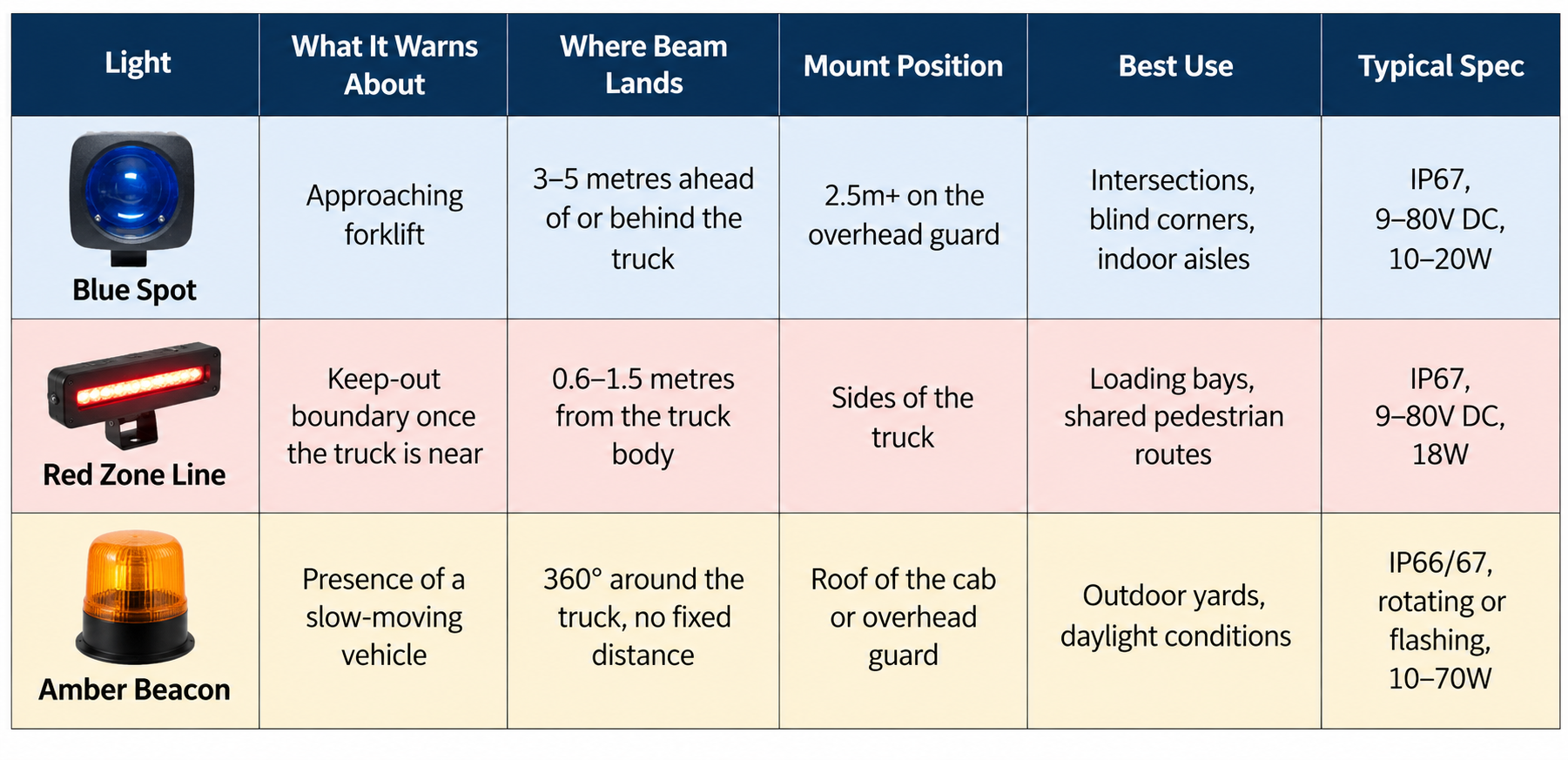
Neither red nor blue replaces roof beacon. An amber beacon says slow moving vehicle is present anywhere in area while red and blue lights tell people exactly where danger zone starts which is why most UK sites run all three.
Narrow aisle and VNA
If it a blue spot front and rear, and skip the red line. The gap between the truck and the racking is already narrower than the red zone's 0.6 to 1.5 metre boundary, so the line would land on the racking instead of the floor and mark nothing. The blue spot still earns its place, because it warns pedestrians and other operators at the aisle end before the truck reaches the intersection, which is what an aisle this tight needs.
Aisle width, racking height and how much pedestrian traffic crosses the route change the answer more than the light specification does. Our guide to forklift safety lights for warehouses works through the choice zone by zone, from VNA racking to dock and yard.
Busy loading bay
Fit both lights at loading bay. The blue spot gives pedestrians warning as truck approaches bay and red line marks boundary once it's manoeuvring at dock. Check how units sit against any existing dock traffic light system before installing since red zone light and red stop signal in same sightline can be misread as one system rather than that of two separate warnings.
Outdoor yard
Switch to amber beacon in outdoor yard and rely on red lines for boundary. Blue spots wash out against daylight and lose their warning value moment sun is on floor so they're wrong choice here regardless of how well they work indoors. The beacon covers presence at distance across an open yard while red line still does close range boundary job it does everywhere else.
