

- Hazardous Zone Classifications (UK/IEC)
- Matching Camera Certification to Zone
- Gas Groups and Temperature Classes
- Oil & Gas
- Chemical & Petrochemical Plants
- Pharmaceutical Manufacturing
- Wastewater & Utilities
- Mining & Quarrying
- What is an ATEX-rated CCTV camera?
- Is ATEX certification still valid in the UK after Brexit?
- What is the difference between Zone 1 and Zone 2 ATEX cameras?
- Can I install a standard IP camera in a Zone 2 hazardous area?
- How do I read an ATEX camera certification marking?
- Do ATEX cameras work with standard NVR/VMS systems?
- How much do ATEX CCTV cameras cost in the UK?
Summary
This guide covers everything UK Safety and Facility Managers need to know about ATEX CCTV cameras - from understanding ATEX certification and zone classifications to buying the right explosion-proof camera for your site. Learn how to read ATEX markings, match camera specs to Zone 1 or Zone 2 environments, and understand why SharpEagle's certified range is trusted across UK oil, gas, chemical, and industrial facilities.Key Takeaways
- ATEX CCTV cameras are legally required in classified hazardous zones under DSEAR 2002
- Standard IP cameras are not safe or compliant in Zone 1, Zone 2, or dust-classified areas
- Camera certification must match the zone category, gas group, and temperature class of your site
- Post-Brexit, UKCA marking applies alongside IECEx for UK installations
- Full system compliance includes Ex-rated cable glands, junction boxes, and accessories
- SharpEagle supplies certified explosion-proof cameras for Zone 1, Zone 2, Zone 21, and Zone 22 across UK industries
ATEX CCTV Cameras UK: Complete Buying Guide for Hazardous Areas
One ignition event in a classified hazardous zone can destroy a facility in seconds. The financial cost runs into millions. The human cost is far worse. In environments where flammable gas, vapor, or combustible dust is present, every piece of electrical equipment, including CCTV cameras, is a potential ignition source if it is not correctly specified and certified.
Yet many UK facilities are running standard cameras in areas that legally require ATEX CCTV cameras UK regulations mandate. Some managers do not realise the risk. Others inherited legacy systems and assumed someone had already checked compliance. Either way, the legal and safety exposure is real.
This guide gives you the complete picture. You will learn exactly what ATEX certification means for cameras, how to read equipment markings, how to match your camera spec to your zone classification, and what to look for when buying. We will also show you how SharpEagle's explosion-proof CCTV cameras UK facilities rely on can deliver full compliance and 24/7 site visibility in the most demanding environments.
What Does 'ATEX' Mean for CCTV Cameras?
ATEX Directive in Plain English
ATEX stands for ATmosphères EXplosibles. It is the EU directive that covers equipment used in explosive atmospheres, and it was adopted into UK law post-Brexit through retained DSEAR regulations and UKCA marking requirements.
For CCTV cameras specifically, ATEX certification means that the housing, lens assembly, and internal electronics must not produce sparks, heat, or static electricity at levels capable of igniting the surrounding atmosphere. The UK Health and Safety Executive (HSE) is clear on this: any electrical equipment operating in a classified hazardous zone must carry appropriate Ex certification. No exceptions.
A camera that lacks this certification is not just a regulatory problem. It is a live ignition risk sitting inside your facility.
Why Standard CCTV Cameras Fail in Hazardous Zones
Standard cameras, even high-quality industrial CCTV camera products, are designed for general environments. They generate internal heat during operation. Their circuit boards produce low-level electrical arcing. Their housings are not built to contain or resist an internal explosion.
In a Zone 1 or Zone 2 gas environment, those properties can trigger a catastrophic event. Using non-certified equipment is a direct breach of DSEAR 2002 and the Pressure Systems Safety Regulations, creating severe liability for both Facility Managers and Safety Managers personally.
Key Regulation Reference:
- DSEAR 2002 (Dangerous Substances and Explosive Atmospheres Regulations)
- BS EN 60079 Series - Equipment for explosive atmospheres
- IECEx and UKCA marking requirements (post-Brexit UK standard)
Understanding ATEX Zones & Camera Selection
Choosing the right ATEX camera UK operators need starts with understanding how hazardous zones are classified. The zone tells you the likelihood of an explosive atmosphere being present, and that directly determines the protection level your camera must achieve.
Hazardous Zone Classifications (UK/IEC)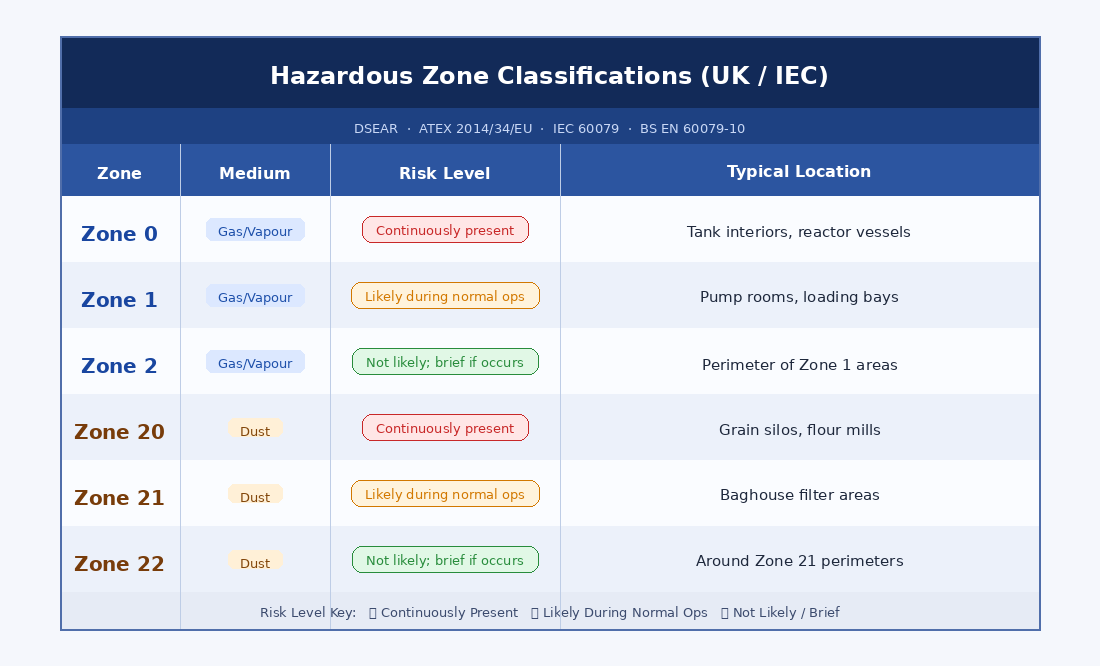
Matching Camera Certification to Zone
Once you know your zone, you match it to the equipment category:
- Category 1 equipment is suitable for Zone 0/20 - the highest protection level
- Category 2 equipment is suitable for Zone 1/21 - this is where most ATEX Zone 1 CCTV camera products sit
- Category 3 equipment is suitable for Zone 2/22 - a lighter but still mandatory protection requirement
An ATEX CCTV camera Zone 1 installation requires Category 2 certification as a minimum. An ATEX CCTV camera Zone 2 application permits Category 3, but that equipment must still carry full EX marking. Using Category 3 in a Zone 1 area is non-compliant, regardless of what a manufacturer claims.
Gas Groups and Temperature Classes
Two more parameters must be confirmed before finalizing any specification. First, the gas group. Cameras must be rated for the gas type present - IIA for propane-type environments, IIB for ethylene, and IIC for the most sensitive atmospheres, such as hydrogen. Second, the temperature class. The surface temperature of your camera must not exceed the auto-ignition temperature of the gas present. T4 or T5 ratings are most common in oil and gas applications.
Skipping either check is one of the most common compliance errors we see in UK facilities.
Key Features to Look for in ATEX CCTV Cameras
Not all ATEX-rated camera products on the market are equal. This practical checklist gives Safety and Facility Managers a clear standard to apply before committing to any purchase.
Must-Have Features
- ATEX/IECEx dual certification, with UKCA marking for UK post-Brexit sites
- IP66/IP67 ingress protection as a minimum
- 316L stainless steel or GRP (glass-reinforced polyester) housing
- Flameproof 'Ex d' or intrinsically safe 'Ex i' rated enclosure
- Operating temperature range of -40 degrees C to +70 degrees C
- HD resolution of at least 2MP, with 4MP or 8MP preferred for wide-area coverage
- IR illumination for 24/7 monitoring without introducing additional ignition risk
- PoE or multi-voltage compatibility (24VAC / 12VDC)
Value-Add Features
- PTZ capability: An ATEX PTZ camera gives wide-area coverage with remote pan, tilt, and zoom from a single installation point
- Wiper and washer system for offshore and wet environments
- Anti-corrosion coating for coastal and marine sites
- Integrated analytics including motion detection and perimeter alerts
- ONVIF compliance for integration with your existing VMS
- Full Ex-certified accessory systems, including junction boxes and cable glands
That last point is critical. A camera can carry full ATEX certification UK regulations require, but if the cable gland connecting it to the conduit is not Ex-rated, the entire installation fails compliance. The only valid standard is full system certification, not just the camera head.
Introducing SharpEagle Explosion Proof Cameras
For UK facilities operating in classified hazardous zones, SharpEagle Technology has been a trusted safety and security partner since 2009. Designed specifically for high-risk industrial environments, our explosion proof CCTV camera range meets the rigorous demands of ATEX and IECEx certification - giving Safety Managers documented compliance and Facility Managers confidence in 24/7 site visibility.
Our ATEX certified CCTV camera systems are engineered for Zone 1, Zone 2, Zone 21, and Zone 22 environments, covering gas, vapor, and dust atmospheres. Our range includes:
- Fixed explosion-proof HD and 4K cameras for perimeter and process monitoring
- PTZ explosion-proof cameras for wide-area patrol and remote operation - our ATEX PTZ camera models are built for the largest and most complex sites
- Compact Ex-rated cameras for confined-space and tight installation scenarios
- Full Ex-certified accessory systems including junction boxes, cable glands, and mounting brackets
Serving UK operators across oil and gas, chemical processing, offshore, pharmaceutical manufacturing, and water treatment, we provide not just cameras but a complete hazardous area surveillance ecosystem. That means support from initial specification and zone classification consultation right through to installation compliance documentation.
Industries & Applications in the UK
The need for explosion-proof CCTV cameras UK operators must deploy spans more sectors than many safety professionals initially expect. Here is where demand is highest and why.
Oil & Gas
Onshore refineries, terminals, and storage depots operate with Zone 1 and Zone 2 classified areas throughout. These sites need both fixed cameras and PTZ units for process monitoring and perimeter security. North Sea offshore platforms add a further layer - they require corrosion-resistant, IP68-rated, weatherproof hazardous area camera UK operators can trust in extreme marine conditions, often with wiper systems for reliable lens visibility.
Chemical & Petrochemical Plants
Solvent storage areas, reaction vessels, and loading bays require ATEX Zone 1 CCTV camera installations with IR capability and integrated analytics. Compliance audit trails are also a growing requirement here - CCTV footage is regularly used as documented evidence during incident investigations and regulatory audits.
Pharmaceutical Manufacturing
Solvent handling areas and spray-drying zones in pharmaceutical plants are commonly classified as Zone 1 or Zone 2. This is one of the most overlooked ATEX environments in UK manufacturing. Many facilities still run standard cameras in these areas without realizing the regulatory and safety exposure they carry.
Wastewater & Utilities
Sewage treatment sites generate methane in quantities sufficient to classify certain areas as Zone 1. Combined with wet, corrosive conditions, these environments demand fully rated, ATEX rated IP camera installations with IP67 or IP68 housings that can handle both the atmosphere and the environment.
Mining & Quarrying
Dust-classified Zone 21 and Zone 22 environments - particularly those involving coal dust or silica - require cameras carrying Ex tb or Ex tc dust protection markings. A standard ATEX camera UK buyers select for gas environments will not automatically cover dust zones. The marking must specifically address the dust hazard present.
How to Buy ATEX CCTV Cameras in the UK - Step by Step
Procurement without a structured process leads to dangerous gaps. This roadmap helps Facility and Safety Managers buy with confidence and arrive at full compliance from day one.
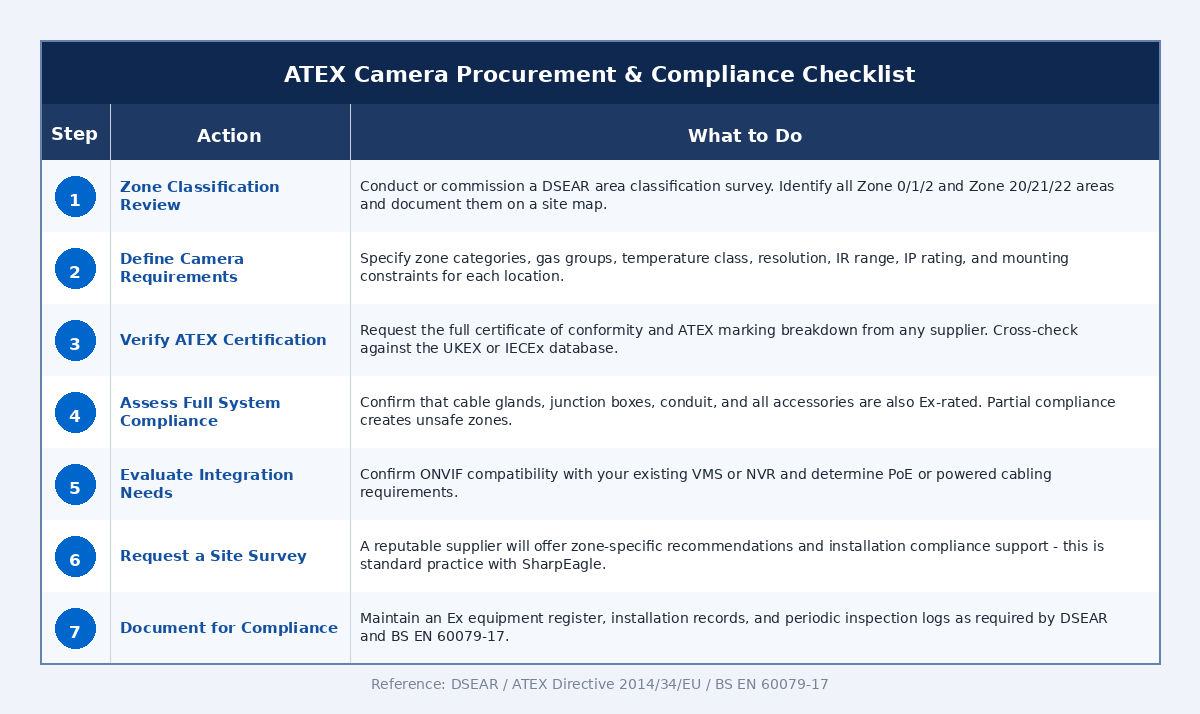
Taking shortcuts on any of these steps creates compliance gaps that will surface during an HSE inspection - or worse, during an incident investigation after an event has already occurred.
Get Expert Help From SharpEagle
Getting ATEX surveillance right is not just about buying a camera. It is about zone-matched specification, full system compliance, and installation documentation that holds up to HSE scrutiny. Our UK-experienced team works with Facility Managers and Safety Managers across oil and gas, chemical, offshore, and industrial sectors to deliver explosion-proof camera systems that are certified, integrated, and built to last.
Contact SharpEagle today for a no-obligation technical consultation.
Frequently Asked Questions
What is an ATEX-rated CCTV camera?
An ATEX rated camera is a camera that has been tested and certified to operate safely in explosive atmospheres. The certification confirms the camera will not produce sparks, excess heat, or static discharge capable of igniting flammable gas, vapor, or dust. All electrical equipment used in DSEAR-classified hazardous zones in the UK must carry this certification.
Is ATEX certification still valid in the UK after Brexit?
ATEX certification from notified bodies remains valid for equipment already installed. For new equipment placed on the UK market, UKCA marking now applies. IECEx certification is also widely accepted. Confirming current ATEX certification UK requirements with your supplier and HSE guidance is always the right first step.
What is the difference between Zone 1 and Zone 2 ATEX cameras?
Zone 1 requires Category 2 equipment - cameras built to withstand explosive atmospheres that are likely during normal operations. Zone 2 permits Category 3 equipment, designed for atmospheres that are unlikely but possible. Installing Category 3 in a Zone 1 area is a compliance breach regardless of circumstances.
Can I install a standard IP camera in a Zone 2 hazardous area?
No. A standard IP camera carries no Ex certification and poses an active ignition risk in any classified hazardous zone. Even Zone 2 requires Category 3 certified equipment with appropriate Ex markings. A standard camera is a DSEAR violation in any classified area.
How do I read an ATEX camera certification marking?
A typical marking reads: Ex d IIB T4 Gb. 'Ex' indicates explosion protection. 'd' is the protection type (flameproof enclosure). 'IIB' is the gas group. 'T4' is the temperature class. 'Gb' indicates Zone 1 suitability. Always ask your supplier to walk through the full marking against your specific site conditions before purchasing.
Do ATEX cameras work with standard NVR/VMS systems?
Yes, provided the camera is ONVIF compliant. Most modern ATEX certified CCTV camera products support the ONVIF protocol, which allows integration with the majority of standard NVR and VMS platforms. Always verify compatibility before committing to a purchase.
How much do ATEX CCTV cameras cost in the UK?
Pricing varies by certification level, resolution, housing material, and features. Entry-level fixed explosion proof CCTV camera units start from a few hundred pounds. High-specification ATEX rated IP camera models with PTZ capability for offshore or Zone 1 gas environments can reach several thousand pounds. The cost of non-compliance - HSE fines, site shutdown, and incident liability - is significantly higher than any camera investment. Contact SharpEagle for a detailed quote based on your specific zone and site requirements.
