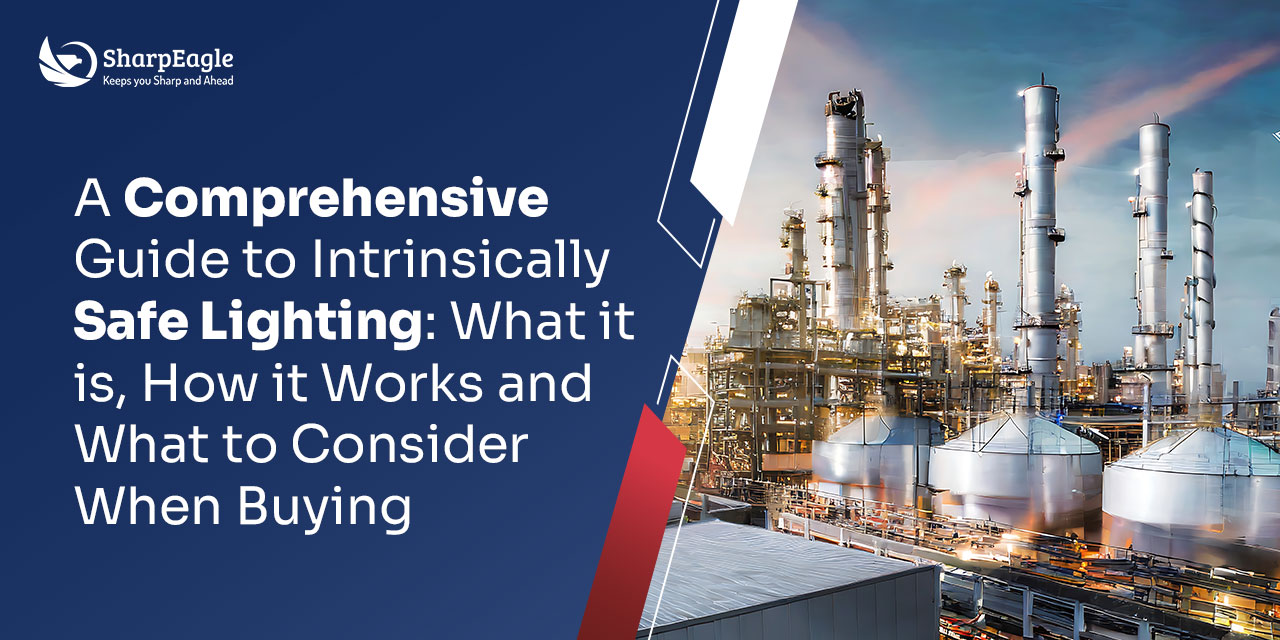
In many hazardous work environments, lighting is an essential tool to ensure the safety of workers. However, in areas where explosive gases, vapours, or dust are present, the use of traditional lighting sources such as incandescent bulbs or fluorescent lamps can be dangerous. That's where Intrinsically Safe lighting comes in. In this definitive buyers guide, we'll explore everything you need to know about IS lighting, including what it means, why it's important, how it's certified, and what to consider before buying.
Industries across the United Kingdom, United Arab Emirates, and Saudi Arabia—such as oil & gas, chemical processing, and mining—operate in environments where flammable gases, vapours, or dust are present. In such conditions, even a small spark or heat source from standard lighting can lead to serious accidents.
To eliminate this risk, businesses rely on intrinsically safe lighting, a specialized solution designed to prevent ignition at the source. Unlike traditional lighting systems, these lights are engineered to operate safely even in the most hazardous zones.
Intrinsically Safe is a term used to describe equipment that is designed to operate in hazardous environments without posing a risk of causing an explosion or fire. This means that IS equipment is constructed in a way that it won't ignite or create sparks, even if it encounters flammable materials. Intrinsically Safe lighting is designed to prevent sparks or hot surfaces from igniting flammable substances in the air.
The use of Intrinsically Safe LED lighting is critical in hazardous work environments because it minimizes the risk of ignition and explosion, which can cause severe damage to people and property. In addition, LED lights are highly energy-efficient, which can save money on energy costs while reducing the carbon footprint. LED lights also have a longer lifespan than traditional lighting sources, which means less maintenance and replacement costs.
LED lights are made up of electronic components, such as resistors and capacitors, which can generate heat when electrical energy passes through them. It's unusual for LED lights to catch on fire, making them a safe option. They operate at a low temperature, which is the cause. One of the main reasons why light bulb fires occur is overheating. If the bulb heats up excessively, it may harm the fixture, melt it, or heat the surroundings to the point of igniting a fire.
Intrinsically Safe products are certified by testing agencies such as UL, CSA, and ATEX. These agencies evaluate the design and construction of the product to ensure that it meets the necessary safety standards. The certification process involves rigorous testing and evaluation to ensure that the product will not cause an explosion or fire in a hazardous environment. Products that pass the certification process receive a certification mark indicating that they are safe for use in hazardous environments.
Intrinsically Safe lights are designed to prevent sparks and heat from igniting flammable substances, while explosion-proof lighting is designed to contain an explosion if it occurs. Explosion-proof lights are typically constructed with thicker, more durable materials that can withstand an explosion without shattering or breaking. Both types of lights are suitable for use in hazardous environments, but the choice depends on the application's specific needs.
When choosing intrinsically safe (IS) lighting, there are several key considerations to keep in mind. In this definitive buyer's guide, we will explore these factors and why you should consider purchasing intrinsically safe (IS) lighting from SharpEagle.
The first step in selecting intrinsically safe lighting is to determine the hazardous classification of the work environment. Different environments require different types of intrinsically safe (IS) lighting, such as explosion-proof, dust-ignition-proof, or non-incendive lighting. Choosing a lighting solution that meets the specific classification requirements of your work environment.
The lighting requirements of the work environment will also impact the selection of intrinsically safe (IS) lighting. Consider factors such as the size of the area that needs to be illuminated, the type of work being performed, and the brightness level needed. This information will help determine the type and number of lights needed.
The light source is another important factor to consider. Intrinsically safe lighting can use either LED or fluorescent bulbs. LED lighting is generally more energy-efficient, long-lasting, and has a brighter light output. Conversely, fluorescent lighting is less expensive upfront and offers a wider range of colour temperatures.
The power supply for intrinsically safe (IS) lighting must be specially designed to prevent any electrical energy from sparking and igniting the atmosphere. There are two types of power supplies: AC and DC.
There are different types of intrinsically safe (IS) lighting solutions available, including handheld flashlights, headlamps, and area lighting. Consider the specific needs of your operation and choose the type of lighting that best suits your requirements.
The brightness and colour temperature of the light are important factors to consider. Make sure the lighting solution provides sufficient brightness for the task at hand and that the colour temperature is appropriate for the environment.
Battery life is an important consideration, especially for portable lighting solutions. Look for lights with a long battery life that can withstand extended use in hazardous environments.
SharpEagle is a trusted supplier of intrinsically safe lighting solutions that meet the stringent safety standards required in hazardous work environments. Here are the reasons why you should consider purchasing intrinsically safe lighting from SharpEagle:
The UK follows ATEX and DSEAR regulations for hazardous environments.
Intrinsically safe lighting helps:
In the UK, regulatory compliance + offshore operations drive adoption.
The UAE has large-scale industrial and energy infrastructure operating in extreme climates.
IS lighting is critical for:
In the UAE, environment + industrial scale increase demand.
Saudi Arabia operates some of the world’s largest oil & gas and petrochemical facilities.
Intrinsically safe lighting helps:
In Saudi Arabia, hazard level + industrial expansion drive adoption.
If you're looking for reliable and safe lighting solutions for hazardous work environments, SharpEagle is a trusted provider of intrinsically safe lighting products. Our high-quality, custom solutions and excellent customer service make us a top choice for businesses prioritizing safety and quality. Your employers and your business would never have to compromise on safety when it comes to lighting in hazardous environments. Choose us for intrinsically safe lighting solutions that meet the highest safety standards.
Intrinsically safe lighting is a type of lighting designed for hazardous environments where explosive gases, vapours, or dust may be present. It works by limiting the electrical and thermal energy within the device so that it cannot produce sparks or heat capable of igniting the surrounding atmosphere, even in case of faults.
It works on the principle of energy limitation, where the electrical and thermal energy in the circuit is kept below the level required to cause ignition. This ensures that even if a fault occurs, the device cannot generate a spark or temperature high enough to trigger an explosion.
Intrinsically safe lighting prevents explosions by eliminating ignition sources, while explosion-proof lighting is designed to contain an explosion within a sealed enclosure. Intrinsically safe systems are generally used in higher-risk zones where prevention is critical.
It is commonly used in oil and gas facilities, chemical plants, mining operations, and other hazardous environments where flammable substances are present. These industries require lighting solutions that can operate safely without increasing explosion risks.
It is important because it helps prevent catastrophic accidents by removing ignition risks. In hazardous environments, even a small spark can lead to serious incidents, so using intrinsically safe lighting ensures both worker safety and regulatory compliance.
Intrinsically safe lighting must meet certifications such as ATEX, IECEx, and UL, which verify that the equipment is safe for use in explosive environments. These certifications ensure that the lighting has been tested under strict safety conditions.
Yes, intrinsically safe lighting is suitable for use in all hazardous zones, including Zone 0, which is the highest risk level. However, the specific type of lighting must match the zone classification and environmental conditions.
It depends on the application. Intrinsically safe lighting is better for preventing ignition in high-risk environments, while explosion-proof lighting is suitable where containment is required. In many cases, both technologies are used together for maximum safety.