If you spend even five minutes inside a busy warehouse today, you will notice one thing immediately. Everything is moving. Fast. Forklifts are constantly on the go. Workers are walking between aisles. Orders are being picked, packed, and dispatched almost non-stop. There is very little pause in between.
Now think about this. In such a fast-paced environment, how easy is it for people and machines to actually notice each other at the right time? This is where the problem begins.
Across the UK, UAE, and KSA, warehouses have evolved rapidly due to e-commerce growth. But as operations have become faster and more complex, the number of pedestrian forklift accidents has also started to rise.
It is not because people are careless. It is because the environment itself makes it harder to stay aware all the time.
Let’s look at it in a practical way.
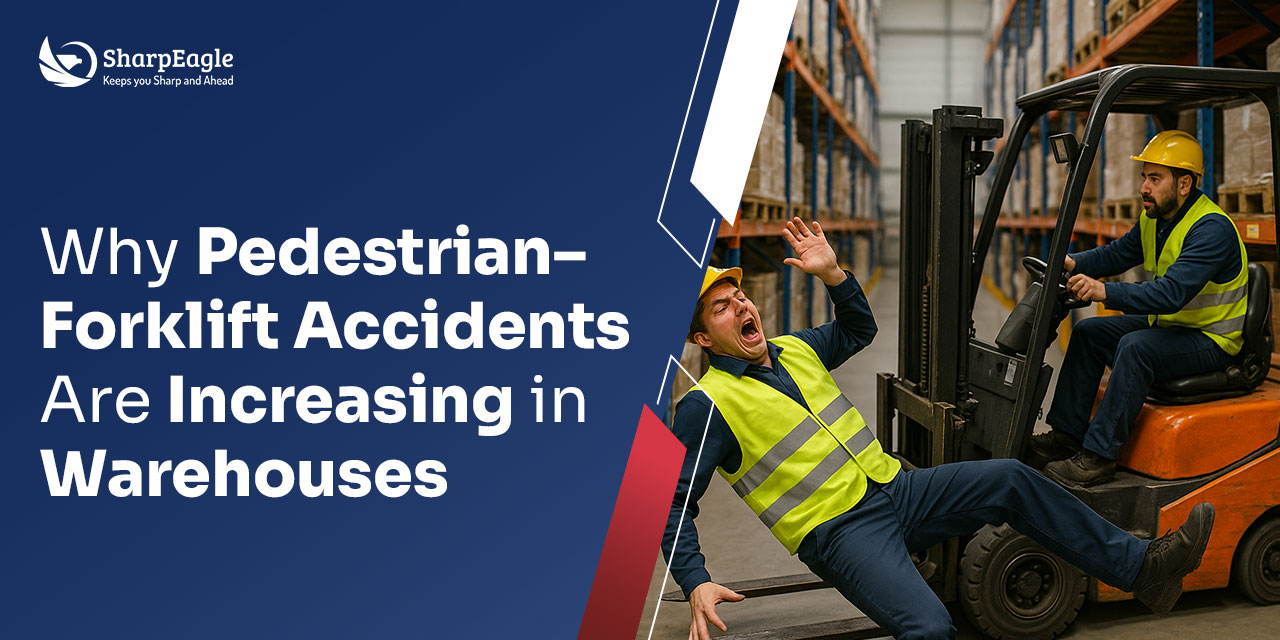
A pedestrian forklift accident is not always a dramatic collision. Sometimes it is a near miss that could have turned serious. Sometimes it is a small impact that leads to injury. What makes these incidents dangerous is the gap in perception.
The forklift operator thinks, “The path looks clear.”
The pedestrian thinks, “They can see me.”
But in reality, neither is completely sure.
Forklifts are large machines. They carry loads that block visibility. They operate in tight spaces. On the other hand, pedestrians are focused on their own tasks and often assume they have enough time to move. This mismatch is exactly why pedestrian forklift accidents continue to happen, even in well-managed warehouses.
When you look deeper, these accidents are rarely caused by just one issue. It is usually a combination of factors that build up over time.
In many warehouses, forklifts and pedestrians share the same space. There are no clear boundaries, and movement overlaps constantly. A worker might step into an aisle to save time while a forklift is already approaching from the other end. Both are doing their jobs, but the lack of separation creates risk.
Common situations you will often see
This is one of the main reasons why forklift accidents in warehouse environments are increasing.
Visibility is one of those things people don’t think about until something goes wrong. Blind corners, tall racks, and insufficient warehouse safety lighting make it difficult to see what is coming next. A forklift can appear suddenly, or a pedestrian can step into view at the last moment.
Some common visibility challenges include
In these situations, even a one-second delay can make all the difference.
Let’s be honest. Warehouse work is not easy. Long hours, repetitive tasks, and constant pressure can lead to fatigue. And when people are tired, their reaction time slows down. Even trained operators following OSHA forklift safety guidelines can make small mistakes. Pedestrians, too, can get distracted or lose focus.
Some typical human factors include
These small lapses can quickly turn into serious incidents.
Not every part of a warehouse carries the same level of risk. Some areas naturally become more dangerous because of how they are used. Cross aisles and intersections are one of the biggest trouble spots. This is where different movement paths meet, and visibility is often limited. A forklift might approach from one side while a pedestrian crosses from another, and neither sees the other in time.
Loading docks are another challenging area. They are busy, noisy, and often involve multiple activities happening together. Forklifts, trucks, and workers all operate in close proximity, which increases the chances of accidents. Packing and dispatch zones also create pressure. Workers are focused on speed, and forklifts are constantly moving in and out to transport goods. This creates a situation where awareness can easily drop.
Some common characteristics of high risk areas
Recognizing these zones is a key step in improving industrial warehouse safety.
When an accident happens, the impact is not limited to that moment. The first and most important concern is always the safety of employees. Injuries can lead to long recovery periods and affect people both physically and emotionally. But the impact also extends to the business. Operations can slow down or stop. There may be compensation claims, higher insurance costs, and even legal consequences. Repeated incidents can also affect employee confidence and overall workplace morale.
Some of the wider impacts include
This is why companies are now taking forklift safety solutions more seriously than ever before.
As warehouses become more complex, safety solutions need to evolve as well. One of the most practical and effective solutions is the use of forklift safety lights. These lights project visible warnings on the floor, allowing pedestrians to notice an approaching forklift before it actually appears.
This small change makes a big difference. Instead of reacting at the last moment, people become aware in advance.
Other solutions also support this approach
Together, these forklift safety solutions create a safer and more controlled environment.
Here is something interesting to think about.
In a noisy warehouse, how often do people actually respond to alarms? Now compare that to a bright light moving across the floor. People notice it instantly. This is why forklift safety lights are so effective. They change how people behave without needing constant reminders. When workers see a light, they naturally slow down or step aside.
Some key advantages of safety lighting
This makes it a powerful tool for forklift accident prevention.
Let’s look at a real-world type of scenario.
A warehouse was experiencing frequent near misses, especially at intersections and loading areas. Despite using alarms and signage, incidents continued to happen. After reviewing the situation, the management identified poor visibility and mixed traffic as the main issues. They introduced forklift safety lights, including blue spot lights to indicate movement and red line lights to create safety boundaries. Workers were also trained to understand what these lights meant.
Within a few months, the change was clear.
This shows how the right approach to forklift accident prevention can deliver real results.
Improving safety is not about one single solution. It is about combining the right strategies. Start with clear traffic management. Define where forklifts should move and where pedestrians should walk. This reduces confusion and overlap. Upgrade warehouse safety systems, especially lighting, to improve visibility in all areas. Regular training ensures that everyone understands the risks and follows safe practices.
Some practical steps include
When these steps are followed consistently, the risk of pedestrian forklift accidents reduces significantly.
The rise in pedestrian forklift accidents is not just a safety issue. It is a reflection of how warehouses are changing. Faster operations, shared spaces, and constant movement have made it harder to rely on traditional safety methods alone. But the good news is, these risks can be managed.
By focusing on better visibility, smarter forklift safety solutions, and stronger warehouse safety practices, businesses can create environments where both people and machines operate safely.
Because at the end of the day, safety is not just about avoiding accidents. It is about making sure everyone goes home safe.
They are increasing due to faster operations, more interaction between forklifts and pedestrians, poor visibility, and lack of clear separation in busy warehouse environments.
The most common causes include mixed traffic zones, poor lighting, blind spots, operator fatigue, and human error.
Blind spots prevent operators from seeing pedestrians in certain areas, especially during turning or reversing, leading to delayed reactions.
Yes, forklift safety lights are highly effective because they provide clear visual warnings and help pedestrians detect forklift movement early.
Warehouses can improve safety by implementing traffic plans, upgrading lighting systems, using visual warning solutions, and conducting regular training and safety audits.