In industrial workspaces — from busy UK distribution centres to massive logistics yards in the UAE or large storage facilities in Saudi Arabia — forklifts move constantly and often operate in close proximity to personnel. While audible alarms alert workers to vehicle movement, visual warning lights are an increasingly important safety solution that ensures hazards are communicated clearly and early.
Two common visual systems are blue forklift safety lights and red forklift safety lights. Though both improve visibility, they serve distinct roles and are best deployed in different scenarios. Understanding the difference between these lights can help safety managers, operations teams, and facility planners choose the right tools to reduce collisions, support pedestrian awareness, and prevent accidents in industrial environments.
Forklifts are powerful and valuable machines, but can also be dangerous if not used properly. It is essential to follow safety guidelines and best practices when operating a forklift to prevent accidents and injuries. Here are some key points to remember when it comes to forklift safety and security:
* Only trained and certified individuals should operate a forklift. It is essential to thoroughly understand the machine's controls and proper operation before attempting to use it.
* Always wear the proper personal protective equipment (PPE), including a hard hat, safety glasses, and closed-toe shoes.
* Inspect the forklift before use to ensure it is in good working condition. Check for damaged or worn parts, and report any issues to a supervisor.
* Follow proper load-handling techniques to prevent accidents. This includes keeping the load balanced, not overloading the forklift, and being aware of the load's stability and size.
* Use caution when driving the forklift, especially in crowded or confined areas. Always look out for pedestrians and other vehicles, and use your horn to warn others of your presence.
* Keep the forklift adequately maintained and stored when not in use. This includes ensuring that it is properly charged or fueled and keeping it in a secure location to prevent unauthorized use.
By following these safety guidelines, you can help to prevent accidents and injuries and ensure that forklifts are used safely and efficiently in your workplace.
However, apart from the above mentioned points, the application of Blue and Red lights has also helped significantly reduce forklift collisions and harm. Let's learn about the two lights and what they stand for in the safety and security protocols for Forklifts.
In this article, we shall dive into Blue Forklift safety lights and Red Forklift safety lights and determine when and where the two are used and what signs they mean and depict the vital roles they play in the environments they work in.
Both red and blue forklift safety lights work well as a warning system.
By focusing a vibrant light on the floor ahead, rear, as well as along the sides of your forklift, they inform nearby people and other forklift drivers of the direction and speed of your forklift's approach.
Your forklifts have blue safety lights attached to their rear or front ends. Depending on where they are mounted, they shine a vibrant blue light on the floor ahead or in the rear of your forklift.

The light can shine anywhere from 10 to over 18 feet away from your forklift, depending on the projection angle and the vibrancy of the beam. The light shows your forklift's path and speed as it moves across the floor.
When you are going in reverse on your forklift, it is particularly hard so that you, as an administrator, can check whether there is any person or thing behind you.
When your view is limited, a blue safety light attached to your vehicle's rear will alert the other vehicle or the other person of your presence.
It's also hard to see what's ahead of you when lifting a heavy load with a forklift. If you install the blue safety light on your vehicle’s front, it will let people ahead of you know you are approaching, so they can clear the way.
Forklift Red Safety Lights form a safe distance line along the forklift's side. Your Vehicle’s sides are equipped with red safety lights for forklifts. They project an intense, red streak of light between two and five feet in front of the forklift. The light can be angled to change this distance.

This red-line also referred to as the halo-zone, is a boundary that runs along your forklift. It tells you how far away you should stay from your forklift. Walkers or different forklifts should avoid the red line to be careful.
Forklifts pivot on their front wheels and steer from the rear axle. As a result, when the forklift turns, its back end acts as a counterweight and swings wide.
The forklift's rear end could swing, leading to striking a pedestrian or another object if the operator lacks comprehension or control.
The red well-being light instructs a walker how far to stay away from a forklift to refrain from being hit by a backside swing.
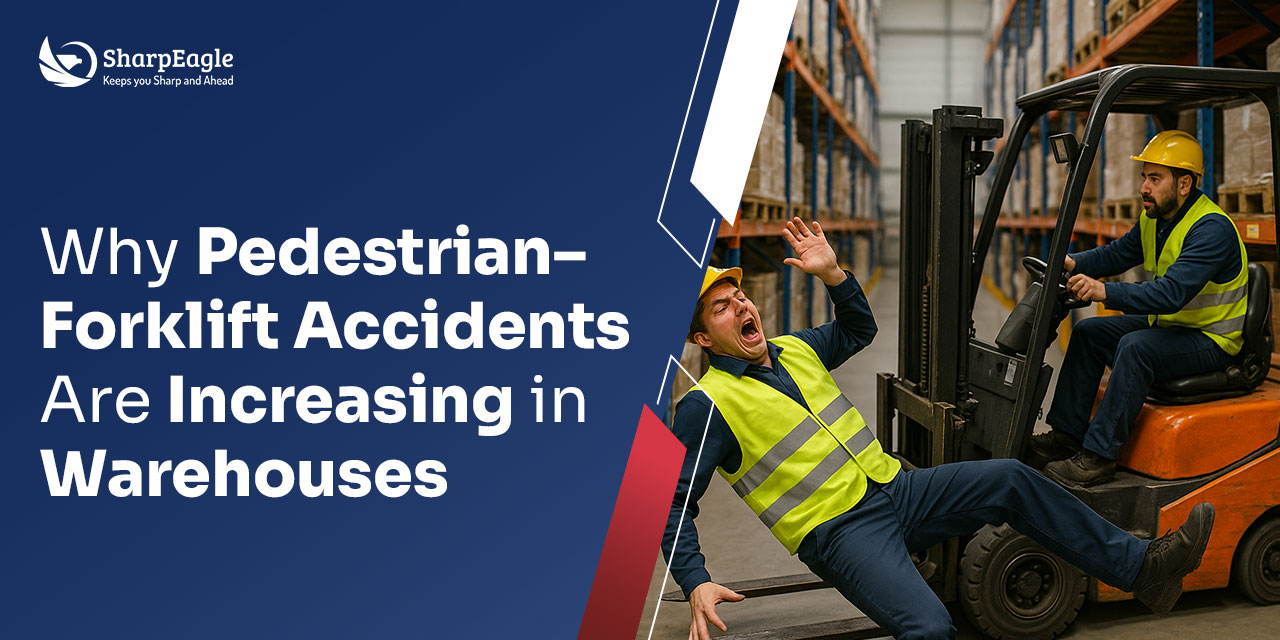
According to estimates from the Occupational Safety and Health Administration (OSHA), forklift accidents account for almost a hundred and one fatalities and ninety-seven thousand plus injuries yearly. Those figures are mind-boggling!
In addition, a person being struck by a forklift in motion is the leading cause of death in these accidents. Forklift lights can significantly reduce the number of accidents like these.
Workers can become so used to the noise of forklifts and other sounds in their immediate environment that they stop noticing signs of danger. Workers or pedestrians may also be wearing noise-cancellation headgear, making it impossible to hear a coming forklift.
Your employees might also be looking at their cell phones or data on their clipboards.
A moving, bright blue or red light on the ground in their direction will sternly catch their attention and alert them to imminent hazards, granting them time to stop or move aside to avoid being struck and injured.
One of the most effective ways to warn pedestrians that a forklift is coming is to use safety lights in blue and red.
You will not only keep pedestrians in your facility safer by installing blue and red safety lights on your forklifts, but you will also reduce the number of collisions between your material handling equipment.
Other forklift operators can easily see the blue and red safety lights. On the floor of your warehouse, their bright beams of light form a protective perimeter that makes it easy to see where your equipment is moving. There will be a very distinct boundary that other operators should never cross.
This brings us to the end of the article, and we hope you’re now well-informed about the workings of the Red and Blue Safety Lights of a Forklift, they will ensure that proper warnings are always there for the operator as well as the nearby objects and people and will prevent many collisions from occurring. If you need any assistance with Forklifts and also its equipment You can e-mail us at sales@sharpeagle.uk, and we’ll help you with all the details, you can also visit our website at SharpEagle: Top Exproof CCTV's and safety solutions provider for all the latest updates and products.
1. What’s the main difference between blue and red forklift safety lights?
Blue lights signal approach and movement, while red lights mark danger or restricted zones around forklift operations.
2. Do these lights work in noisy environments?
Yes — visual safety lights are particularly effective where audible warnings are masked by machinery noise.
3. Can blue and red lights be used together?
Absolutely — using both provides layered safety: blue for early warning and red for danger zone delineation.
4. Where should these lights be installed?
Blue lights are best on the front/overhead guard; red zone lights are effective around sides or load swing areas.
5. Do safety lights reduce accidents?
Yes — when integrated with training and safety protocols, they significantly lower pedestrian-forklift collisions.